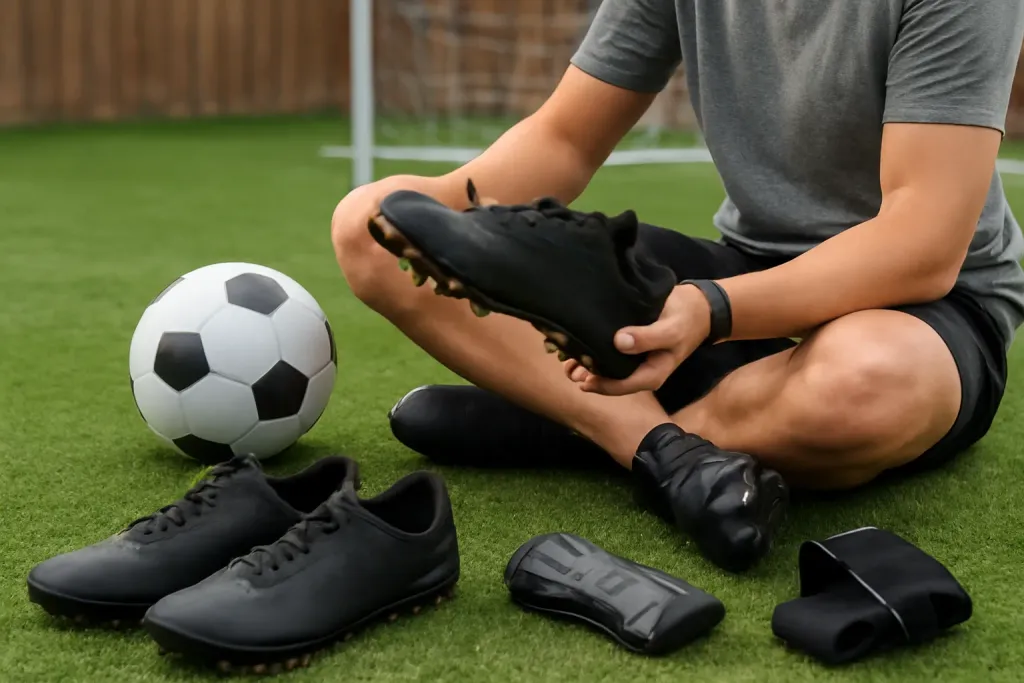
What Turf Shoes and Cleats Mean in Youth Soccer
When families compare turf shoes vs cleats youth soccer, the main question is usually simple: which shoe fits the surface where a child will play most often? Turf shoes and cleats are both made for soccer, but they are not built for the same field conditions.
Turf shoes are designed for artificial turf and other hard, even surfaces. They usually have many small rubber studs or nubs on the outsole. Cleats are the more traditional soccer shoe, with studs that are usually more pronounced and intended for natural grass or mixed outdoor fields. In youth soccer, the best choice often depends less on the word “soccer” and more on where practices and games actually happen.
For parents, volunteer coaches, and PE teachers, the goal is to match the shoe to the setting so the child can focus on the activity itself. A shoe that fits the field can be easier to use and more comfortable for regular play, while the wrong outsole can feel awkward on the surface it is asked to handle.
When Turf Shoes Make Sense
Turf shoes are a practical option for many young players who spend most of their time on artificial turf. They can also work well on hard-packed fields, playground-like practice areas, and some indoor soccer spaces, depending on the facility rules. Because the outsole uses many smaller contact points instead of fewer tall studs, turf shoes tend to feel more stable on short-pile synthetic surfaces.
They are often a good fit for beginners because the design looks closer to a sneaker than a classic cleat, which can make them feel familiar during the first few practices. That can matter for younger kids who are still learning how to run, stop, and turn while wearing soccer-specific footwear.
For youth leagues that use turf for both practice and games, turf shoes may be the most versatile choice. They are also convenient for families who want one pair that can handle school fields, rec-center sessions, and neighborhood practice spots without needing to swap between shoe types constantly.
Still, turf shoes are not a one-size-fits-all answer. If a child plays primarily on natural grass, especially fields that are softer or uneven, turf shoes may not provide the type of outsole many players expect for that setting. The field surface should always come first in the decision.
When Cleats Are the Better Pick
Cleats are the familiar choice for many outdoor soccer settings, especially natural grass. Their studded outsole is intended to give the shoe a more traditional soccer feel on grass fields. For youth players who are joining a league that uses outdoor grass for games, cleats are often the standard option parents are asked to buy.
There are also different styles of cleats, and not every cleat is meant for the same surface. Some are made for firm natural grass, while others are built for softer fields. For families shopping in the youth category, the most important part is not memorizing every outsole type, but checking the field guidance from the league or coach before buying.
Cleats may feel less casual than turf shoes when first put on, especially for very young players. The studs create a different walking sensation off the field, and some children need a little time to get used to that. That does not make them better or worse overall; it simply means the experience can be different from what a child feels in everyday sneakers.
If the season includes both grass games and turf practices, some families choose to buy one pair for the main surface and another pair for backup or mixed use. Others stick with the pair that matches the primary field and accept that it may not be ideal everywhere else. The right answer usually depends on how often the child plays and where.
Why the Playing Surface Matters Most
In the turf shoes vs cleats youth soccer conversation, the surface is the biggest factor. Many problems people worry about are really surface-mismatch problems. A shoe that fits the field can feel more natural for walking, warming up, and playing. A shoe that does not match the field can feel like the wrong tool for the job.
Artificial turf generally calls for turf shoes or, in some cases, certain indoor-compatible soccer shoes if the facility allows them. Natural grass usually points toward cleats. If a field is muddy, very soft, or uneven, league guidance becomes especially important because some fields have rules about allowable shoe types.
For families who are new to soccer, it helps to ask three questions before shopping: Where are practices held, where are games played, and does the league specify a footwear type? Those answers usually narrow the choice quickly. A shoe labeled for soccer is not enough by itself; the surface still matters.
Schools and community programs can make the decision even easier by telling parents what the main surface will be for the season. If that information is not clear, a quick check with the coach or organizer is worth it before ordering a pair that may not suit the field.
Browse our recommended gear
Our featured picks refresh periodically. While we update them, our editorial guides can help you find the right gear.
See our guidesFit, Comfort, and Ease of Use for Kids
For youth soccer, fit matters as much as outsole type. A child who cannot get the shoe on and off comfortably, or who feels cramped in the toe area, is unlikely to enjoy wearing it. That is true whether the shoe is a turf shoe or a cleat.
Parents often find that younger children do better with shoes that feel simple and secure. Easy closures, manageable tongue placement, and a comfortable heel hold can be more important than choosing the most specialized style. When kids are still learning to dress themselves for practice, convenience becomes part of the value.
Because youth feet can change quickly, it is smart to check size with the socks the child usually wears for soccer. A shoe should feel snug enough to stay secure but not so tight that the child feels crowded. If there is uncertainty, trying on more than one size is often more useful than comparing styles from a distance.
Comfort also includes how the child feels walking from the car, standing during a team talk, or moving around before warm-up. Turf shoes often feel more like everyday athletic shoes off the field, while cleats are more specialized. That difference may help a child who is new to organized sports, especially in younger age groups.
How the Right Choice Can Change by Age and Use
The best option is not always the same for every age group. Younger players in entry-level programs may spend more time on practice fields than in intense competition. In that case, a pair that works well on the main practice surface may be the most practical buy. For many families, that means turf shoes if the program uses artificial turf.
As kids move into more organized league play, field rules and game surfaces matter more. Some teams practice on turf but play on grass, while others do the reverse. A child in a recreational league may only need one pair for the whole season, while a player in a multi-field community program may encounter several surfaces in a single week.
Volunteer coaches and PE teachers often appreciate footwear that matches the day’s activity without adding confusion for families. Clear communication can help: if the program is mostly on turf, say so. If games are on grass, note that too. Simple guidance can prevent last-minute scrambling and reduce the odds that a child shows up in the wrong shoe type.
Families who are just starting out do not need to overcomplicate the decision. The more the season involves one stable surface, the easier the choice becomes. The more the surfaces vary, the more useful it is to ask the coach or league for direction before buying.
What to Check Before You Buy
When comparing youth soccer shoes, it helps to focus on the basics. First, confirm the playing surface. Second, check the league or school guidance. Third, make sure the fit works for the child’s current size and comfort level. Those three steps solve most of the decision.
It is also useful to look at the outsole pattern without assuming that more studs automatically means better performance. Turf shoes and cleats are built for different jobs, so the right pattern is the one that matches the field, not the one that looks most aggressive.
Families shopping online should read the product description carefully and look for wording such as turf, artificial turf, firm ground, or grass. Those labels give a stronger clue than the generic term “soccer shoe.” If the listing is unclear, it is safer to keep shopping than to guess.
For kids who may use the same pair in multiple settings, versatility can be appealing, but it should not replace surface matching. A shoe that can handle several surfaces in a basic way may still be less suitable than a shoe made for the main field. The best choice is often the one that fits the most common use case, not every possible scenario.
A Simple Bottom Line for Families
If the question is turf shoes vs cleats youth soccer, the quickest answer is this: turf shoes usually make more sense on artificial turf, while cleats usually make more sense on natural grass. From there, the rest of the decision comes down to the child’s age, the league’s rules, and how often the season changes surfaces.
For beginners and recreational players, there is value in keeping the choice straightforward. Match the shoe to the field, check the fit, and follow the program’s guidance. That approach is practical for parents, coaches, and schools trying to keep youth soccer simple and organized.
When in doubt, ask the team contact before buying. A clear answer about the main field is usually all you need to choose between turf shoes and cleats with confidence.