Eyewear, pads & guards

Youth Protective Sports Gear: Fit, Labels and Sizing

Helmets, shin guards and catcher's gear all depend on fit and on the right label. This hub shows what each sport usually asks for, how each piece is sized, and which certification to look for, from NOCSAE, Little League, CPSC and the makers' own charts.

Quick answer: how to buy protective gear for a child

Ask the league what it requires, measure the child, buy the size that fits now, and look for the certification label that applies: NOCSAE for football, batting and catcher's helmets, and CPSC for bike helmets. Shin guards are sized by height. We do not rank helmets and we make no claims about what any piece of gear prevents. Our guides cover football helmets, batting helmets, catcher's gear and shin guards.
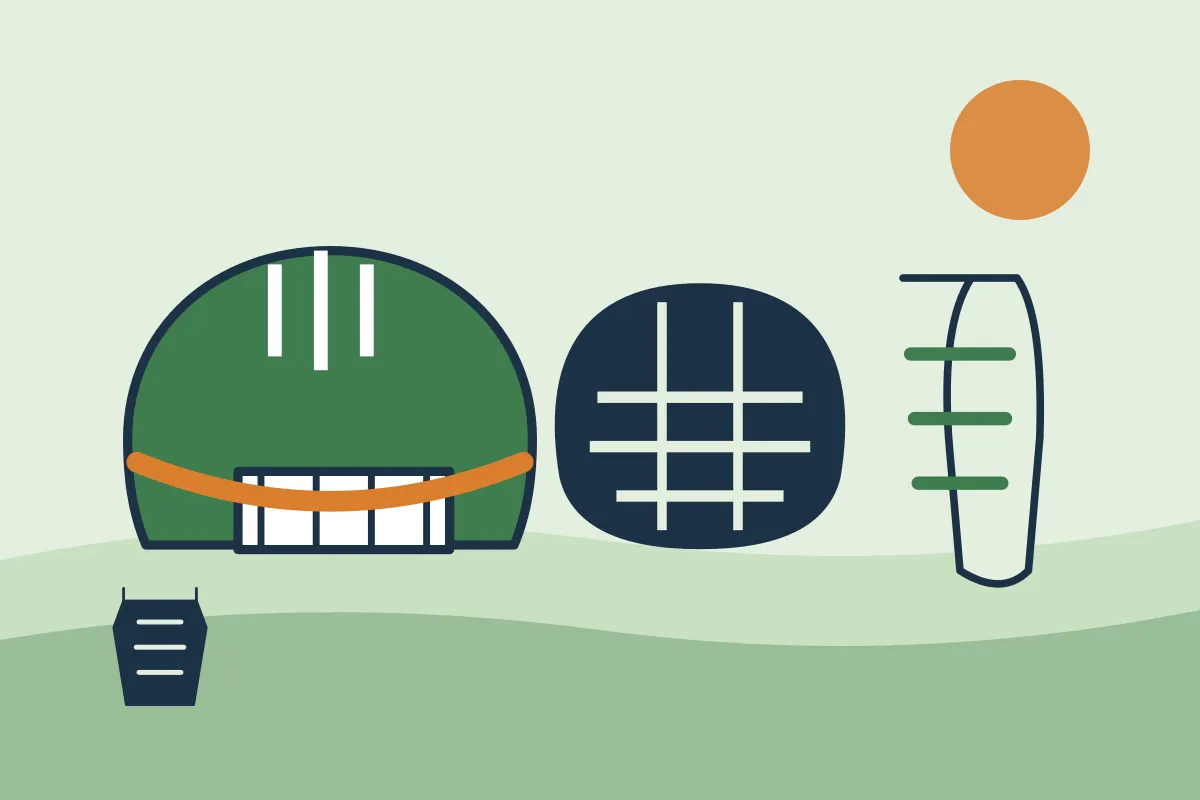
Original illustration of a football helmet, a catcher's mask and a shin guard on a grassy field

Shop sports gear on Amazon

Sponsored

As an Amazon Associate, FindSportsUSA earns from qualifying purchases. See our affiliate disclosure.

Prices and availability were accurate when retrieved from Amazon and may change. Retrieved Nov 22, 2026.

Protective gear by sport at a glance

Protective equipment is the one part of a child's kit where a wrong size is not just uncomfortable. A helmet that is too big shifts, shin guards that are too long press on the ankle, and a chest protector that does not cover the torso leaves the child with the extra weight and little of the purpose. At the same time, parents are often told they must buy everything before the first practice, which is rarely true: many leagues supply helmets and pads, or lend a shared set.

This hub is the one place that lists what each sport usually asks for, how it is sized, and which certification label to look for. It draws on NOCSAE and Little League's own pages, the Consumer Product Safety Commission, and Nike, adidas, Giro and Bell sizing charts. It does not give medical advice or rank gear on safety, and it does not replace a fitting by a coach or trained fitter.

Protective gear by sport
Sport and itemWho usually supplies itHow it is sizedLabel to look forOur guide
Football helmetOften the league; askHead circumference, then the maker's chart and a trained fitterNOCSAE label and recertification dateFootball helmets
Baseball or softball batting helmetOften the team or familyHead circumference and the maker's chartNOCSAE mark (Little League requires it)Batting helmets
Catcher's helmet, chest protector, leg guardsOften a shared team setTorso, lower leg and head measurementsNOCSAE on the helmet; ask the league for the restCatcher's gear
Soccer shin guardsFamilyStanding height, per the maker's chartAsk the league; no single labelShin guards
Bike helmetFamilyHead circumference in cm or inchesCPSC statement (16 CFR Part 1203)Bike helmet chart
Racquet sport eyewear and glovesFamilyBy face or hand size per the makerAsk the facility or leagueRacquetball goggles

Sizes and ranges here are makers' and leagues' published guidance, not a measurement of your child. Kids grow at different rates: check fit in person and follow your league's equipment rules.

The five rules we apply on every page

These are the same rules we follow in every protective-gear guide. They are about fitting and labels, not about outcomes.

  1. League rules come first

    Required gear, stamps and sizes vary by league and age group. Ask before you buy, and follow the league's list over any chart here.

  2. Buy for the child you have

    A helmet should fit now. Do not buy one for a child to grow into; a 2016 USA Football blog post we read quotes Riddell saying the same.

  3. Measure, then check in person

    Use a soft tape and the maker's chart as a starting point, then check the fit with the child wearing it.

  4. Look for the label, then check the date

    NOCSAE for football, batting and catcher's helmets. CPSC for bike helmets. For football, check the recertification date on the label.

  5. No medical or safety-rating claims

    We do not say a helmet prevents any injury and we do not name a safest helmet. For health questions, ask a clinician.

Shop sports gear on Amazon

Sponsored

As an Amazon Associate, FindSportsUSA earns from qualifying purchases. See our affiliate disclosure.

Prices and availability were accurate when retrieved from Amazon and may change. Retrieved Nov 22, 2026.

Helmets: football, batting, catcher's and bike

Four kinds of helmet, four different labels. They are not interchangeable: a bike helmet is not a batting helmet, and a batting helmet is not a football helmet.

Helmet labels and checks
HelmetLabel or standardWhat to checkSource
FootballNOCSAEThe label, and the recertification date; a coach or fitter should fit itNOCSAE recertification page
Baseball and softball battingNOCSAE (Little League requires it in practice and games)Mark present; do not paint unless the maker approvesLittle League playing rules, appendix B
Catcher'sNOCSAE for the helmet; mask and throat guard required by Little LeagueMask clears the eyes; throat guard attachedLittle League playing rules, appendix B
BikeCPSC federal standard, 16 CFR Part 1203A CPSC statement in the helmet; size by head circumferenceCPSC bicycle helmet guidance

Sources: NOCSAE: General recertification requirements and recommendations; Little League: Playing rules, appendix B (safety and equipment); CPSC: Bicycle helmets business guidance; USA Football blog: What parents need to know about football helmets (2016, quoting Riddell). Checked .

On football helmets, NOCSAE says recertification is strongly recommended and that where a maker bars recertification the helmet carries a permanent label showing when certification expires, and that life cannot be more than five years. That is why a hand-me-down helmet needs its label read before anything else. Our youth football helmet guide has the head-measuring steps and the questions to ask your league.

Bike helmets are sized from head circumference. Giro lists Youth XS at 45 to 51 cm and Youth S at 49 to 55 cm; Bell lists a Universal Youth at 20 1/8 to 22 7/8 inches. The two charts overlap but do not match, so use the chart for the brand you buy. Replace a bike helmet after a crash. Our bike helmet size chart converts inches to centimeters and shows both makers.

Shin guards: sized by height

Soccer shin guards are the most common first purchase in this category, and the one parents most often get wrong by buying for age. Nike and adidas size by height: Nike's Kids S covers 48 to 51 inches, Kids M 51 to 55, and Kids L 55 to 59; adidas lists Junior S at 3 ft 3 in to 3 ft 10 in, Junior M to 4 ft 6 in, and Junior L to 5 ft 2 in. A guard that sits without pressing on the knee or the ankle is the target.

Kids shin guard size by height
Maker sizeHeightNotes
Nike Kids S48 to 51 inAges 4 to 6
Nike Kids M51 to 55 inAges 7 to 9
Nike Kids L55 to 59 inAges 10 to 12
adidas Junior S3 ft 3 in to 3 ft 10 in39 to 46 in
adidas Junior M3 ft 11 in to 4 ft 6 in47 to 54 in
adidas Junior L4 ft 7 in to 5 ft 2 in55 to 62 in

Sources: Nike: Adults' and kids' shin guards size chart; adidas: Shin guard sizing. Checked .

Whether guards are required is up to the league, and most youth leagues ask for them. Our shin guard size chart adds a height finder, and the soccer hub shows how they fit with the rest of the kit.

Catcher's gear and batting helmets

Little League's appendix B says catchers must wear a catcher's helmet with face mask and throat guard, a chest protector and shin guards, and male catchers a protective supporter and cup. It also says batters wear NOCSAE helmets in practice as well as games, and that batting and catcher's helmets should not be painted unless the maker approves.

Many leagues own one shared set of catcher's gear. If yours does, borrow it for the first season and use your own measurements to check each piece. If your child will catch regularly, measure the torso from the collar bone to the waist and the lower leg from the kneecap to the ankle, and compare with the chart in our catcher's gear guide, which uses All-Star's youth chart. The baseball and softball hub covers the rest of a first-season kit.

Eyewear, mouthguards and the pieces we have not covered

Racquet-sport eyewear and gloves are covered in our racquetball goggles and gloves guide, which treats fit and selection rather than injury claims. Mouthguards, cups and football pads are required by many leagues, and the requirement and the fitting vary so much that the only reliable source is the league. We have not read a maker or league page on mouthguards or football pads, so this hub does not give size numbers for them; where the league names a requirement, follow it.

When you do shop, buy the item whose label and size match the rules, not the one with the most claims on the packaging. If a listing makes a safety promise, treat it as the maker's words: the label and the fit are what you can check.

Gear for this Sponsored

Protective Equipment

A buyer's checklist

Before you buy protective gear
CheckWhyWhere
League listRules differ by league and ageAsk the coach or read the league's rule page
MeasurementCharts are keyed to height, head circumference or torsoOur size tools and guides
Certification labelDifferent gear, different standardThe label inside the helmet
Fit in personA chart is a starting pointTry it on, with the socks or hair the child will have
ReplacementA helmet should be replaced after a crash (bike); football helmets follow the maker's recertificationThe maker's page

Sizes and ranges here are makers' and leagues' published guidance, not a measurement of your child. Kids grow at different rates: check fit in person and follow your league's equipment rules.

Protective Equipment guides and size tools

Every guide and size chart we have for this sport.

Youth football helmets

Fit and certification only, no rankings. Read more about Youth football helmets

Batting helmet fit checklist

Measure, NOCSAE mark and fit steps. Read more about Batting helmet fit checklist

Youth catcher's gear

What Little League requires and how to measure. Read more about Youth catcher's gear

Shin guard size chart

Nike and adidas sizes by height. Read more about Shin guard size chart

Racquetball goggles and gloves

Fit and selection for racquet sports. Read more about Racquetball goggles and gloves

Bike helmet size chart

Head circumference to size, Giro and Bell. Open the tool about Bike helmet size chart

Baseball and softball hub

Bats, gloves and catcher's gear. See the hub about Baseball and softball hub

Youth football hub

Cleats, gloves, ball size and helmets. See the hub about Youth football hub

Soccer hub

Ball size, shin guards and shoes. See the hub about Soccer hub

Frequently asked questions

How do I know what size shin guards to get?

Measure your child's standing height and match it to the chart for the brand you are buying. Nike's Kids S, M and L cover 48 to 59 inches and adidas Junior S, M and L cover 3 ft 3 in to 5 ft 2 in. Then try them on: they should fit without pressing on the knee or ankle.

What equipment does a youth catcher need?

Under Little League rules: a catcher's helmet with face mask and throat guard, a chest protector and shin guards, plus a supporter and cup for male catchers. Other leagues vary, so ask yours which pieces it requires and which it supplies.

How should a batting helmet fit?

Level on the head, snug enough that it does not shift, with the straps adjusted. Measure the head first and compare the maker's chart. See our batting helmet fit checklist.

What label should a youth football helmet have?

A NOCSAE label. Check the recertification date too: NOCSAE says where a maker bars recertification the label shows when certification expires, which cannot be more than five years. A coach or trained fitter should fit it.

Should I buy a helmet for my child to grow into?

No. A helmet should fit now. A 2016 USA Football blog post we read quotes Riddell saying never to buy a helmet thinking a child will grow into it. Measure the head, check the maker's chart and have the fit checked.

Does a bike helmet need a particular label?

Look for the Consumer Product Safety Commission statement inside the helmet. CPSC says bicycle helmets must meet the federal standard, 16 CFR Part 1203. Size by head circumference, and replace the helmet after a crash.

Links on this page are Amazon Associates affiliate links to Amazon search results; we may earn from qualifying purchases. See our affiliate disclosure. Sizes and rules come from the sources named on this page; follow your league's equipment rules.