Beginner Gear · Updated September 7, 2026 ·
By Editorial Team
Youth Basketball Sizing by Age and Height
Why Ball Size Matters
Choosing the right basketball is a simple step that can make the game feel more welcoming for young players. When the ball matches a child’s age, hand size, and general strength, it is usually easier to dribble, catch, pass, and shoot with confidence. That matters for beginners, school gyms, driveway practice, and recreational leagues where the goal is to build comfort with the sport.
The phrase youth basketball size by age is a useful starting point, but age alone does not tell the whole story. Two children the same age can differ a lot in height, hand size, and coordination. That is why families and coaches often use both age and height as a guide, then adjust for the player’s ability to hold the ball comfortably. A ball that is too large can feel hard to control. A ball that is too small may not prepare a player for the next level of play.
For parents and volunteer coaches, the goal is not to chase the biggest ball a child can barely manage. The better choice is usually the one that lets the player move naturally and enjoy repeated practice. In a PE class or community league, that often means starting with a ball that fits the youngest players well, then moving up as the child grows.
Quick Youth Basketball Size Chart
This chart gives a practical starting point for youth basketball size by age and height. It is designed for families, beginners, and recreational settings, not for every possible league rule. If a league or school program has its own ball-size standard, follow that first.
28.5 inches, size 5: Common starting point for many children ages 5 to 8, often fitting players roughly under about 4 feet 6 inches.
28.5 inches, size 5: Also a good option for some players ages 9 to 11 who are still small for their age or new to the game.
29.5 inches, size 6: Often used for players around ages 9 to 12, especially when the child has grown taller and can manage a slightly larger ball.
29.5 inches, size 6: Frequently a fit for youth around 4 feet 7 inches to about 5 feet 2 inches, depending on hand size and comfort.
29.5 inches, size 6: Common in girls’ youth play and many middle-school settings, though local programs may vary.
29.5 inches, size 7: Usually reserved for older youth and adult play, often for players 12 and up who are tall enough and comfortable handling the larger ball.
This is a guide, not a strict rulebook. A smaller child may be ready for a larger ball earlier than expected, while a taller child may still benefit from a smaller size for practice. The best choice is the one that supports control and enjoyment.
Age is the fastest way to narrow down a ball size, but height helps make the choice more accurate. A young player who is tall for their age may handle a size 6 sooner than a smaller peer. A child who is shorter or has smaller hands may feel more confident with a size 5 for longer, even if they are approaching middle school.
As a rough guide, many families begin with these pairings:
Ages 5 to 7: Size 5 is often the best starting point, especially for shorter players and true beginners.
Ages 8 to 10: Size 5 or size 6 may both work, depending on height, hand size, and the setting.
Ages 11 to 13: Size 6 is often a practical choice, with size 7 reserved for players who are ready for the larger adult ball.
Ages 14 and up: Size 7 is common for older youth, though some players may still prefer size 6 for drills or casual play.
Height can help fine-tune the choice within those age ranges. For example, a player under about 4 feet 6 inches often does well with size 5. A child closer to 5 feet tall may be ready for size 6, especially if they are already handling the ball confidently. Once a player is clearly growing into middle-school or high-school proportions, size 7 becomes more practical for standard play.
The best approach is to watch what the player can do comfortably. If they can grip the ball without struggling, dribble it with control, and shoot without the ball feeling oversized in their hands, the size is probably close to right.
Simple Ways to Check the Fit
Parents and coaches do not need special equipment to judge whether a basketball fits well. A few simple checks can help narrow the choice before buying.
Two-hand hold: The child should be able to hold the ball with both hands without feeling like it slips away immediately.
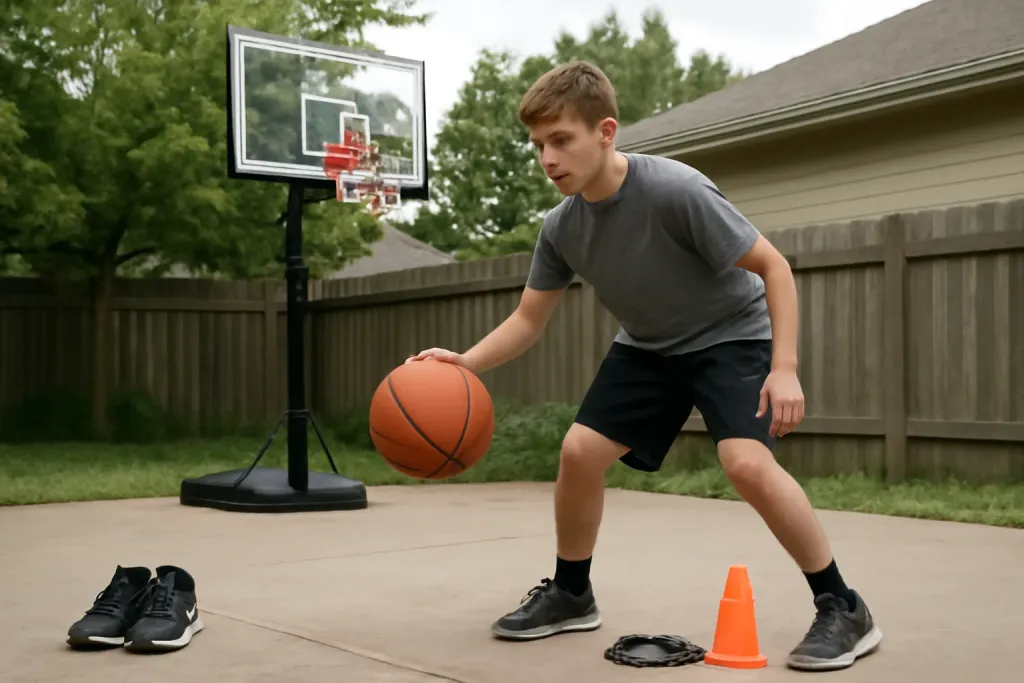
One-hand dribble: The player should be able to bounce the ball with one hand while keeping basic control. If the ball keeps wobbling off line, it may be too large.
Chest-level pass: The child should be able to pass the ball from the chest without looking strained or off balance.
Short shooting motion: The ball should not feel so large that the player must force the shot in an awkward way just to get it up toward the basket.
General comfort: If the player smiles and wants to keep using the ball, that is a strong sign it fits their current stage.
These checks are especially helpful for first-time buyers. A child may look ready for a larger ball simply because they are tall, but the hands may still need a smaller size for comfort. On the other hand, some older children quickly adapt to a larger ball and are ready to move up sooner than the age chart suggests. The goal is not to guess perfectly on the first try, but to choose the ball that makes practice feel manageable today.
In many cases, local rules matter more than a general shopping guide. Recreation leagues, school programs, and PE classes may require a specific basketball size for a certain age group or grade level. If that is the case, it is best to follow the program standard even if a different size seems easier at home.
This is one reason the search for youth basketball size by age can be a little confusing. A family may find one guide that suggests size 5 for a nine-year-old, while another program uses size 6 for the same age group. Both can be reasonable depending on the setting. A youth league may want players to transition earlier so they become familiar with the next size. A beginner clinic may keep younger children on the smaller ball longer so they can build basic confidence.
For volunteer coaches and PE teachers, consistency helps. If a class or team uses the same size ball for everyone in a group, players learn together and drills run more smoothly. If the program includes a wide range of ages or heights, it can also make sense to have more than one size available so smaller players are not left behind.
When in doubt, ask the coach, organizer, or school before buying. That simple step can save families from ending up with a ball that does not match the program’s needs.
Best Choices for Beginners and Recreational Play
Beginners usually benefit from the easiest ball to control, not the largest one they might eventually use. For many young children, that means starting with size 5. It is often a friendly option for driveway practice, backyard games, and entry-level leagues. A smaller ball can make dribbling and passing less frustrating, which helps keep the focus on learning the basics.
For children who are getting older but are still new to basketball, size 6 can be a sensible middle ground. It gives a more advanced feel without jumping all the way to size 7. That can be helpful for players who are growing quickly or moving from elementary to middle-school play.
Recreational players do not always need the exact same ball size used in higher-level competition. If the goal is to have fun, build confidence, and practice at home, a slightly smaller ball may be the better choice. Families often find that one well-chosen ball gets used more often than a larger ball that feels intimidating.
It also helps to think about where the ball will be used. A smaller ball can be easier for indoor practice in a school gym or basement rec area. A larger ball may be more appropriate if the child is already playing in a league that expects that size. For home use, many families choose the ball that best fits the player’s current stage rather than the ball tied to the oldest age group on the chart.
Common Mistakes to Avoid
One common mistake is buying a ball only because the child is getting older. Growth matters, but comfort matters too. A player can be tall for their age and still benefit from a smaller basketball for practice. Another common mistake is assuming that a bigger ball will automatically help a child improve faster. In many cases, the opposite is true if the ball feels unwieldy.
Some families also buy one ball and expect it to work for every child in the house. That can be fine if the children are close in age and size, but it often leads to compromise. If one child is much younger, a single ball may fit one player well and frustrate another. In that case, having two sizes can be more practical.
Another oversight is ignoring the intended use. A ball chosen for casual driveway play may not be the same as the ball a team needs for league practice. Similarly, a child who has just started may not need to “grow into” a larger size right away. For a beginner, the most useful ball is often the one that feels natural today.
If you are buying for a group, keep the range of players in mind. A classroom of mixed heights may need more than one ball size. That makes participation easier and helps avoid turning basketball into a contest over who can manage the heaviest or largest ball.
Before choosing a youth basketball, it helps to run through a short checklist. This keeps the decision practical and reduces guesswork.
Start with the child’s age, then compare it with the usual youth basketball size by age guidance.
Check height and hand size to see whether the child may need a smaller or larger ball than the age chart suggests.
Think about the setting: home use, school PE, rec league, or team practice.
Look for the ball size required by the league or school if a rule already exists.
Choose the ball the player can handle comfortably today, not just the one they might use later.
This simple process works well for parents buying a first basketball and for coaches assembling basic equipment for a group. It also helps families avoid overcomplicating the purchase. In most cases, the right answer is the ball size that matches the child’s current stage and the rules of the program they join.
If you are still deciding between two sizes, the smaller one is often the safer starting point for beginners. Many players grow into a larger ball over time, and a comfortable starting size can keep the game fun while skills develop.
A common starting guide is size 5 for ages 5 to 8, size 6 for many ages 9 to 12, and size 7 for older youth. Height, hand size, and league rules can change the best choice.
Should I choose basketball size by age or height?
Use both. Age gives you a quick starting point, and height helps you adjust for players who are unusually small or tall for their age.
What basketball size should a beginner use?
Most young beginners do best with the smaller size that they can control comfortably, often size 5. Older beginners may prefer size 6 if they are already tall enough and handling the ball well.
Can a child use a bigger basketball to get better faster?
Not necessarily. If the ball feels too large, it can be harder to dribble, pass, and shoot comfortably. A ball that fits well is usually the better choice for practice.
Do school or league rules override general sizing charts?
Yes. If a school, clinic, or league specifies a basketball size, follow that rule even if a general age chart suggests something different.
What if my child is tall for their age?
A taller child may be ready for the next size sooner, but comfort still matters. Test whether they can hold and dribble the ball with control before moving up.
Is a size 7 basketball right for all teens?
Not always. Size 7 is common for older youth, but some younger or smaller teens may still be more comfortable with size 6 for practice or recreational play.
This article reflects independent editorial research and disclosed buying criteria. This is not medical, coaching, or professional safety advice.
Some links on this page are Amazon Associates affiliate links; see our
affiliate disclosure for details.