Overview
Comparing baseball and softball target practice nets mainly comes down to frame material, mesh weight and weave, overall net size, target pocket features, and how firmly the net anchors to the ground. These nets give players a consistent, repeatable target for pitching or throwing practice at home, without needing a catcher or a full field. Because they take repeated impacts from thrown or batted balls, durability under regular use matters more here than with nets used for lighter activities.
This guide breaks down what to look for in each of these areas so you can match a net to your practice space, throwing intensity, and how often you plan to use it. Whether you're setting up a net for a single player working on control or a small group taking turns during a practice session, the same core selection factors apply.
Frame Material and Stability
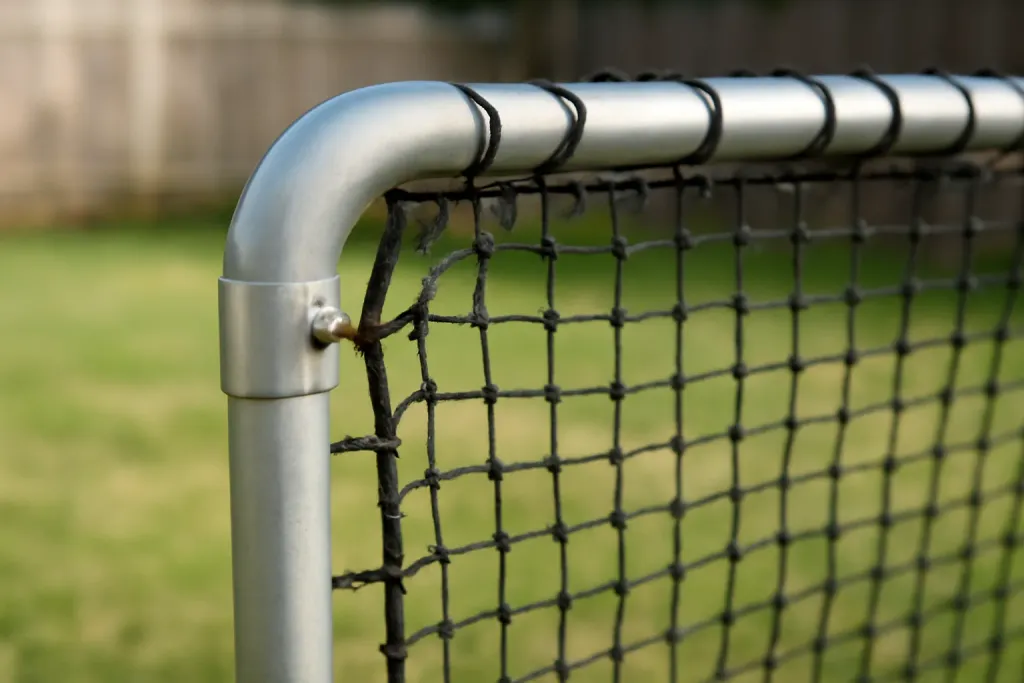
Target nets are typically built around a frame of steel tubing or fiberglass poles, sometimes combined in the same product. Steel frames tend to be heavier and more resistant to bending under repeated impact, which suits players throwing at higher speeds or using the net frequently. Fiberglass poles are often lighter and more flexible, which can help them absorb impact without cracking, though they may flex more noticeably when a ball hits near the frame's edge.
Joint quality matters as much as the tubing itself. Frames that use sleeved or pinned connections generally hold up better over repeated setup and teardown than friction-fit joints that can loosen with use. If you plan to leave the net assembled outdoors for a season, checking how the frame handles wind and impact together, not just impact alone, is worth factoring into the decision.
Mesh Weight and Weave
Mesh is usually rated by weight, often described in ounces per square yard, with heavier mesh generally standing up to repeated hard-hit balls better than lighter mesh designed for lower-intensity use. A finer, tighter weave also tends to reduce ball pass-through and catches balls more cleanly in the netting rather than letting them bounce back unpredictably.
Over time, UV exposure and repeated impact can wear mesh netting, especially at the point where balls consistently strike the target area. Nets with reinforced stitching or double-layered mesh in high-impact zones tend to last longer under frequent use than uniform, single-layer netting, which is a useful detail to check if you expect to use the net several times a week.
Knot type also affects longevity. Knotted mesh tends to hold its shape and resist fraying at intersection points better than knotless mesh, though knotless versions are often lighter and can be gentler on a ball's stitching over time. For a net that will see daily or near-daily use over a season, checking the manufacturer's stated mesh weight and comparing it against similar products is a reasonable way to gauge expected durability before buying.
Net Size for Backyard Space
Target nets range from compact frames suited to a garage or small yard up to larger nets designed for full-motion pitching practice. A smaller net takes up less space and is easier to move or store, but it also gives less margin for wild throws, which matters if you're practicing with less experienced or younger throwers. A larger net offers more forgiveness and a bigger catching area, at the cost of needing more clearance behind and around it.
Measuring your available space, including a buffer zone behind the net for missed throws, helps avoid a net that's too large for the yard or too small for comfortable practice. It's also worth accounting for the throwing distance you plan to use, since a net set up too close to a fence or wall doesn't leave much room to safely retrieve rebounding balls.
Target Pockets for Accuracy Practice
Many target nets include strike-zone outlines or pocket-style targets sewn into the netting, giving players specific spots to aim for during pitching or throwing drills. These targets are usually marked with different pockets representing various pitch locations, which can make practice sessions more structured than simply throwing at an open net.
Pocket targets vary in how firmly balls land and stay put versus bouncing back toward the thrower, which affects how much time you spend retrieving balls between throws. If accuracy training is your main goal, a net with a clearly marked, well-stitched target area is generally more useful than a plain net without any aiming reference.
Browse our recommended gear
Our featured picks refresh periodically. While we update them, our editorial guides can help you find the right gear.
See our guidesGround Anchoring and Safety
Because target nets take repeated impact and can catch wind like a sail, anchoring the frame firmly to the ground is an important part of safe setup. Most nets include stakes or ground anchors, and using them on both the front and back of the frame helps prevent tipping, especially outdoors where gusts can catch a tall net unexpectedly. On harder surfaces where stakes won't drive in, sandbags or weighted anchors are a common alternative.
When younger players are practicing, adult supervision and clear spacing around the net and throwing lane help keep the area safe, particularly when multiple people are retrieving balls near an active throwing line. Checking that the frame is fully stable before starting a session, rather than assuming it will hold once balls start hitting it, is a simple habit worth building. For more backyard practice setups, see our guide to portable soccer rebounders for children.
Portability and Setup Time
Most backyard target nets are designed to be broken down and moved, but "portable" covers a wide range of actual setup effort. Pop-up style frames can be up in under a minute but tend to be lighter-duty and less stable in wind. Pole-and-joint frames take longer to assemble -- often five to fifteen minutes the first time, faster after that -- but generally hold up better to repeated impact from thrown or hit balls.
If the net will be set up and taken down every session (for example, in a shared yard or a space that needs to be clear for other uses), a lighter, faster-assembly frame is usually worth the stability trade-off. If it's going to stay in place for a season, the more substantial pole-and-joint style is typically the better long-term choice.
Either way, check the packed dimensions against available storage space before buying -- a net that assembles small can still have surprisingly long individual poles that don't fit neatly into a garage corner or closet.
Practice Drills a Target Net Supports
A target net is primarily useful for repetition-based accuracy work -- throwing or pitching at marked pockets from a consistent distance, rather than any kind of live batting practice. Setting a consistent throwing distance and simply counting successful hits to each pocket is a straightforward way to use one without needing a coach present.
For younger players, shortening the throwing distance and using larger target pockets keeps the drill achievable and reduces frustration, while older recreational players can move back and aim for smaller pockets as accuracy improves. None of this requires or implies any kind of formal training program -- it's simply a way to get more useful repetitions in a backyard setting.
As with any thrown-ball activity, keep bystanders and pets out of the throwing lane, and supervise younger kids around the net's frame and stakes, since a net that's been struck repeatedly can shift position over a session.
Final Thoughts
A good baseball or softball target net comes down to matching frame material and mesh weight to how often and how hard you'll be throwing, sizing the net to your available space, and anchoring it firmly before every session. Getting these basics right makes for a more durable, safer setup that holds up over a full season of backyard practice.
Taking a few extra minutes at setup to check frame joints, mesh tension, and ground anchors pays off over a season of repeated use, and it's a habit worth building into your practice routine rather than treating as an occasional chore. Browse our Training Accessories hub for more practice gear to round out your setup.