Overview
A portable soccer rebounder for children is a small, lightweight frame with a taut net that bounces a passed or kicked ball back toward the player, letting one child practice passing and first touch without a second person or a wall. For kids, the right choice is usually a compact frame — often in the 3 to 5 foot width range — that's light enough to carry, easy for a parent to set up in a few minutes, and low enough to the ground that it doesn't dominate a small backyard.
This guide covers how to size a rebounder for a child versus an adult, what adjustable-angle nets are actually for, how to anchor one safely on grass, when indoor use makes sense, and a few simple drills a rebounder supports at a recreational level.
Rebounders are popular partly because they solve a common problem for families: a young player who wants extra touches on the ball doesn't always have a sibling, parent, or friend free to pass with them. A well-sized, properly anchored rebounder fills that gap safely, giving a child a consistent practice partner that folds up and stores in a closet or garage corner when not in use.
Sizing for Kids vs Adults
Rebounders scale roughly with the player. Youth models are typically smaller and lighter than adult training rebounders for a few practical reasons:
- Lower net height matches a child's kicking height, so passes rebound at a catchable or trappable level instead of sailing over their head.
- Narrower frame width keeps the whole unit light enough for a child (with adult help) to move and store, and fits better in a typical backyard corner or driveway edge.
- Lighter overall frame material — often thinner tubing — reduces the risk of injury if the frame tips, compared to a heavier adult-sized unit.
A rebounder sized for an adult training program is usually overkill for a young child and can be harder for a parent to set up and break down repeatedly, which often means it ends up used less often than a smaller, faster-to-deploy option.
If more than one child in the household will use the same rebounder, sizing for the youngest regular user is usually the more practical approach, since older kids can still use a slightly smaller net comfortably, while a younger child struggles more with an oversized one. Families with a wide age range sometimes find it easier to have one mid-sized rebounder that works reasonably well for everyone rather than separate units for each child.
Adjustable Angle Nets
Many rebounders let you tilt the net's angle, usually through a few notches on the frame's support legs. A more vertical angle sends the ball back roughly toward where it came from, which is useful for straightforward passing repetition. Angling the net changes where the rebound lands, which can be used to vary the direction a child needs to move to receive the next touch. For young kids just starting out, keeping the net closer to vertical is usually simplest — the added complexity of an angled rebound is more useful once a child is comfortable controlling a ball that's coming back at an unpredictable angle.
Some frames also let you adjust overall net tension, which changes how firmly the ball rebounds. A looser net absorbs more of the ball's energy and sends it back more gently, which can be a helpful setting for a younger or less experienced child who's still building confidence receiving a moving ball.
Anchoring Safely on Grass
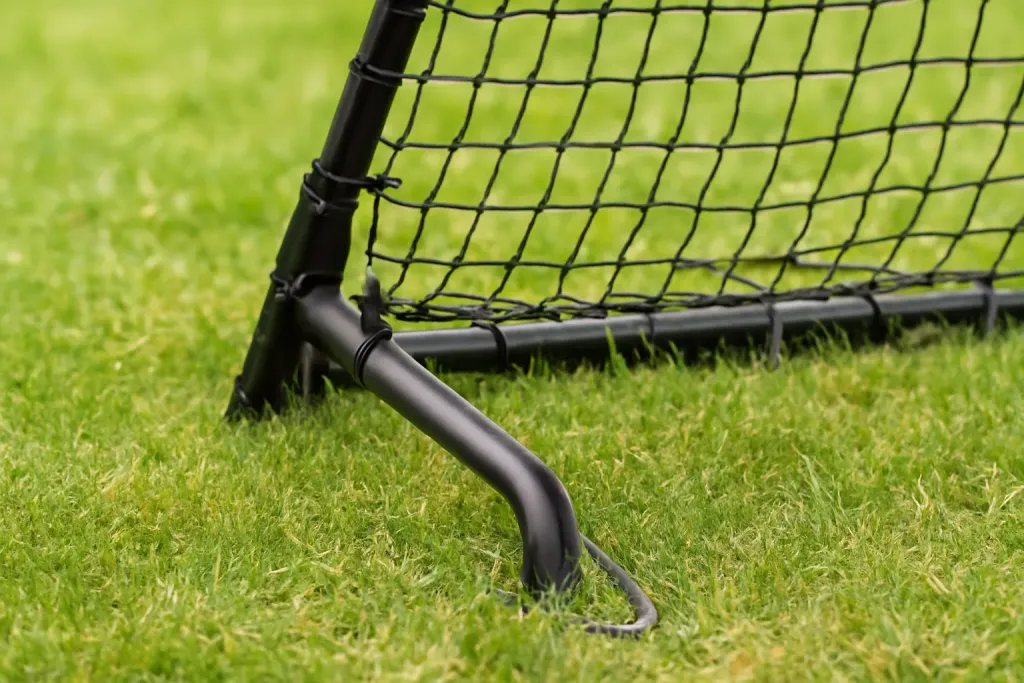
Even a light rebounder can tip if a ball is struck hard directly into it, so anchoring matters, particularly with younger kids nearby. Most portable models include ground stakes that slide through loops or grommets at the base of the frame and push into soil. A few practical points:
- Stake all available anchor points, not just one or two corners, so the frame resists tipping from multiple angles.
- Check stakes periodically during play, since repeated impacts can work them loose in soft ground.
- On hard surfaces like a driveway or patio where stakes won't work, look for a model that includes weighted sandbag pockets or a wide, low-profile base instead.
- Keep younger siblings and pets clear of the frame's footprint during active kicking, since a tipped frame is a trip and impact hazard, not just an equipment issue.
It's also worth checking soil condition before assuming stakes will hold. Very dry, hard-packed dirt can make stakes difficult to seat fully, while very loose or sandy soil may not grip the stake well even when it's pushed in deep. A quick tug test on each stake after setup — gently pulling to confirm it resists — takes only a few seconds and catches a poorly seated stake before a child starts kicking.
Indoor vs Outdoor Use
Some compact rebounders are marketed for both indoor and outdoor use, but the practical considerations differ. Outdoors on grass, ground stakes anchor the frame and the net can handle occasional rain if it's a weather-resistant mesh. Indoors, there's usually no way to stake the frame, so a rebounder needs enough base weight or a wide enough footprint to stay put on a hard floor, and the surrounding space needs enough clearance that a missed trap doesn't send the ball into furniture or a window. For most families, a rebounder used primarily in a backyard or driveway with occasional indoor use in bad weather is a reasonable default, rather than buying separate units for each setting.
If you do plan to use a rebounder indoors regularly, a softer training ball rather than a standard outdoor ball reduces the risk of scuffed walls or broken items nearby, and playing on carpet or a rug rather than bare hardwood cuts down on both noise and the ball skidding unpredictably after a rebound.
Browse our recommended gear
Our featured picks refresh periodically. While we update them, our editorial guides can help you find the right gear.
See our guidesBasic Drills a Rebounder Supports
At a recreational, coordination-building level, a rebounder supports a handful of simple repetitions rather than structured performance training:
- Pass and receive. Pass the ball into the net and control the return with a first touch, repeating to build comfort with the ball coming back unpredictably.
- Two-touch passing. Receive the rebound with one touch and pass it back with the next, encouraging quicker ball movement.
- Weak-foot practice. Alternate which foot receives and passes, since a rebounder gives a child many repetitions in a short session.
- Counting games. Younger kids often enjoy simply counting how many consecutive clean touches they can string together, which keeps a session playful rather than repetitive.
These are fun, repetition-based activities appropriate for young players rather than a substitute for coached practice, and a parent or adult should supervise setup and early sessions to make sure the frame is stable and the play area is clear. Short sessions of ten to fifteen minutes tend to hold a young child's attention better than longer stretches, and ending on a positive note — a good streak of touches, for example — keeps the activity feeling like play rather than a chore.
Storage and Portability Between Sessions
Most kid-sized rebounders fold or collapse for storage, but the packed size still varies enough between models that it's worth checking before buying, especially for households without a garage. A rebounder that folds flat can usually lean against a wall or slide under a bed, while bulkier frames need more dedicated storage space.
If the rebounder will travel to a park or a relative's yard rather than staying in one backyard, a lighter frame with a simple carry bag is worth prioritizing over a heavier, more rigid frame that's harder to transport.
Supervision and Realistic Expectations
A rebounder is a practice aid for repetition, not a substitute for supervised play or formal coaching. Younger kids should be supervised around the frame and any ground stakes, and the rebounder should be anchored on a flat, open area away from windows, parked cars, or other kids not involved in the drill.
Kept in perspective, a rebounder is simply a way to get more first-touch and passing repetitions without needing a second person to return the ball every time -- a modest, practical addition to backyard practice rather than a training system.
Final Thoughts
A portable soccer rebounder sized for a child, set up on a stable, staked base, gives kids an easy way to get extra touches on a ball without needing a second player every time. Keep the frame appropriately sized, anchor it properly, and supervise setup so the equipment stays safe and fun rather than becoming a hazard.
Because most of these frames fold flat or break down into a few pieces, storage between sessions is usually simple — a garage wall hook, a closet corner, or even a large duffel bag works for most compact models. Rinsing off grass clippings or mud after outdoor use and letting the net air-dry before folding it away also helps it hold up over multiple seasons. See our training accessories hub for related gear, including our guide to youth agility ladders and cone sets for building out a simple backyard practice area.