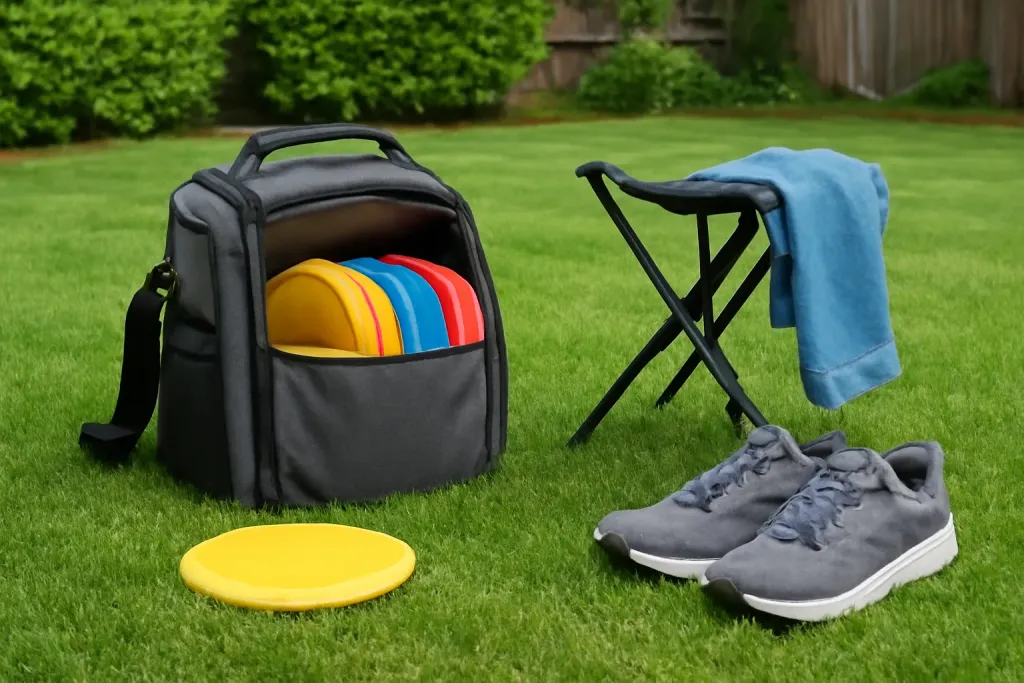
What to Look for First
Choosing a disc golf bag for beginners starts with a simple question: what will you carry most often? A new player usually does not need a large tournament-style bag. For casual rounds, school programs, park outings, and family play, the best first bag is usually one that is easy to lift, easy to organize, and not so large that it feels cumbersome when only a few discs are packed inside.
Before focusing on extra pockets or premium materials, think about the basics. A beginner bag should hold a small set of discs, a water bottle, and a few everyday items such as a towel, scorecard, or keys. It should be comfortable to wear while walking from hole to hole, and it should be simple enough that a beginner can keep track of everything without digging around.
For many families and first-time players, the goal is convenience. A bag that is too large can invite overpacking, while one that is too small may not leave room for a growing disc collection. The right starting point is a bag that matches the way the player will actually use it: short practice sessions, recreational rounds, school activities, or weekend park play.
Common Bag Types and How They Differ
Beginners will usually encounter three broad bag styles: small starter bags, shoulder bags, and backpack-style bags. Each has a different balance of size, comfort, and organization. Understanding those differences makes it easier to choose a disc golf bag for beginners without overspending on features that may not be needed yet.
Small starter bags: These are compact and often carry only a handful of discs. They are a good fit for absolute beginners, younger players, or anyone who wants a very light carry.
Shoulder bags: These offer a middle ground. They usually hold more discs than a basic starter bag and may include a pocket or two for accessories. They are familiar and simple, though weight rests on one side.
Backpack-style bags: These are built to distribute weight across both shoulders and typically provide more organization. Some beginners like the extra space, especially if they expect to add more discs over time.
The best style depends on comfort, the number of discs needed, and how far the player expects to walk. For a beginner who is still learning the game, simplicity often matters more than capacity. If the bag will be shared among family members, it may help to choose a flexible style with room for both discs and small personal items.
Capacity and Organization
Capacity is one of the most important details when choosing a disc golf bag for beginners. A small set of discs is usually enough at the start, so a bag does not need to be oversized. What matters more is whether the bag keeps items separated in a way that feels easy to use. Beginners benefit from a layout that makes it obvious where each disc belongs.
A simple interior is often ideal. Open disc storage works well when the player carries only a few discs and wants quick access. If the bag has divider pockets, those can help organize putters, midrange discs, and fairway drivers, but they are not essential for a first bag. Extra pockets can be useful for a mini marker, sunscreen, scorecard, pencil, towel, or phone, yet too many small compartments may create clutter.
It can also help to think ahead. A beginner may start with a compact set of discs but add more over time. A bag with a little extra room can support that gradual growth without forcing an immediate upgrade. At the same time, a bag that is too roomy can encourage unnecessary packing, making the load heavier than it needs to be. The best choice usually strikes a middle balance: enough space for current needs, with a little margin for future use.
Comfort, Fit, and Carrying Style
Comfort matters because a bag that feels awkward is less likely to be used consistently. For beginners, the carrying style should feel natural and manageable. If the player is small-framed, young, or simply prefers light gear, a compact bag may be the easiest option. If the player plans to walk a full course regularly, a backpack style may feel more balanced than a single-strap design.
When comparing bags, pay attention to how the weight is carried, how the straps rest on the body, and whether the bag stays stable while walking. Adjustable straps can be helpful for different body sizes, especially in family settings where one bag may be shared or used by more than one person. A bag should sit securely without needing constant adjustment.
For parents, volunteer coaches, and PE teachers, comfort also affects supervision and setup. A bag that is easy to lift, set down, and repack can be useful in group settings. If younger players are involved, a lighter bag may be easier for them to manage independently. The right fit supports a smoother experience overall, which can make a new player more confident about bringing the bag along.
Browse our recommended gear
Our featured picks refresh periodically. While we update them, our editorial guides can help you find the right gear.
See our guidesMaterials and Practical Durability
Beginners do not need to study every fabric detail, but it helps to look for materials that can handle regular use. Disc golf bags often get placed on grass, dirt, concrete, or the floor of a vehicle, so a practical outer material and a sturdy base are useful. A bag that holds its shape well is usually easier to load and unload.
Durability for beginners is mostly about everyday convenience. Reinforced stitching, basic water resistance, and a bottom that resists wear can make a bag feel more dependable during routine use. This does not mean a beginner needs a heavy-duty model. In many cases, a moderate, well-built bag is enough for recreational play and school use.
It can also be helpful to think about cleanup. Families and teachers often appreciate gear that can be wiped down or brushed off after use. A simple design with fewer hard-to-reach corners is usually easier to maintain. If the bag will be used outdoors with kids or in shared programs, easy care may matter as much as appearance.
Match the Bag to the Player and Setting
The best beginner bag depends on who will use it and where it will be used. A casual adult player who only brings a few discs to a local course may want a small shoulder bag or a compact backpack. A child or younger teen might do better with a lightweight starter bag that is easy to handle. A parent buying for a family outing may prefer a bag with simple pockets and enough room for shared accessories.
For school programs and PE settings, durability and simplicity often matter more than maximum capacity. A bag should be easy to assign, easy to store, and easy to check at the end of class. If several students will use similar bags, a plain layout can help reduce confusion. For volunteer coaches, the most useful bag is often one that keeps basic gear organized without taking up much space.
There is also a difference between a bag for occasional recreation and one for regular course play. A beginner who expects to play only a few times a year may not need much more than a starter bag. Someone who wants to practice frequently may appreciate extra room and a more comfortable carry. Matching the bag to the setting helps avoid buying more gear than necessary.
Smart Buying Tips for First-Time Buyers
When shopping for a disc golf bag for beginners, it helps to focus on a few simple questions rather than trying to compare every detail. First, how many discs will the player carry most of the time? Second, will the bag be used for short casual outings or longer walks on a course? Third, is the bag for one person, or will it be shared by a family or group?
It can also help to think about what not to prioritize. A first bag does not need every advanced feature available. Very large storage, multiple accessory pockets, or a complex layout may be unnecessary if the player is still learning the basics. In many cases, a clean and straightforward bag will be easier to live with than a more complicated one.
Another useful approach is to choose a bag that leaves room to grow. Beginners often start with a few discs and add others later, so a bag with modest extra space can be a practical middle ground. That said, bigger is not always better. The right size is the one that fits the current routine comfortably and keeps the experience simple.
Final Check Before You Buy
Before making a final choice, run through a quick checklist. Does the bag hold the number of discs the beginner will actually carry? Is it comfortable enough for the expected walking distance? Is it easy to pack, carry, and store? Does it seem simple enough for a new player to use without frustration?
If the answer to most of those questions is yes, the bag is probably a solid match. Beginners usually benefit most from gear that removes barriers and keeps the focus on learning the game. A well-chosen bag does not have to be fancy to be effective. It simply needs to support the player’s routine in a practical way.
For families, schools, and community programs, that practical approach is often the best one. The ideal bag is one that feels manageable from day one and remains useful as interest in the sport grows. By keeping the decision centered on fit, comfort, and everyday use, shoppers can choose with more confidence and less guesswork.