Overview
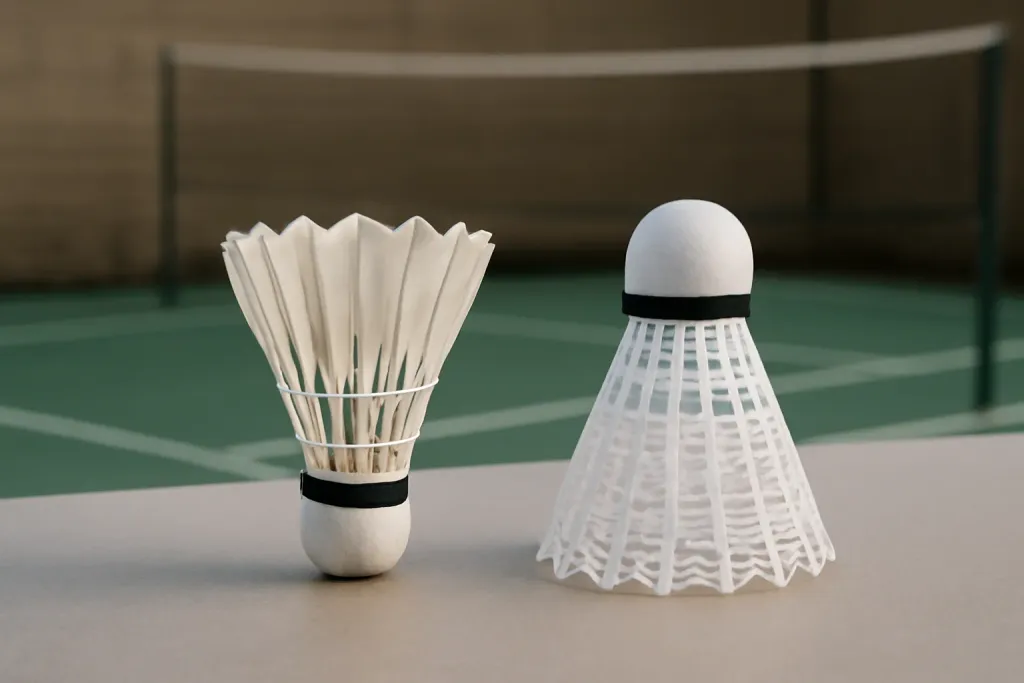
For most recreational and outdoor badminton play, nylon shuttlecocks are the more practical choice, mainly because they hold up far better to mis-hits, ground contact, and casual storage than feather shuttles do. Feather shuttlecocks, made from real feathers set into a cork base, are the type used in competitive and indoor club play because of their flight characteristics, but they're fragile and comparatively expensive for backyard use. This guide compares the two directly across the factors that matter most for casual players: durability, wind performance, cost, flight consistency, and how to care for each.
Durability Comparison
Nylon shuttlecocks use a molded plastic skirt instead of individual feathers, which makes them far more resistant to the kind of contact that destroys feather shuttles quickly — mishit shots, ground strikes, or bouncing off a fence or patio edge. A single nylon shuttle can often last through many sessions of casual outdoor play. Feather shuttlecocks, by contrast, can lose individual feathers or bend after just a few hard hits, especially against hard surfaces, and a shuttle with even one damaged feather flies noticeably differently. For backyard games where shuttles regularly hit grass, pavement, or fences, nylon's durability advantage is significant.
Wind and Outdoor Performance
Both shuttle types are affected by wind since shuttlecocks are inherently light, but they respond somewhat differently. Nylon shuttles, being slightly heavier and more uniform due to their molded skirt, tend to hold a more predictable path in light breeze than feather shuttles, whose natural feathers can catch wind unevenly, especially as they wear. That said, neither type is well suited to strong or gusty wind — outdoor badminton in general plays best in calm or lightly breezy conditions regardless of shuttle choice. For a yard or park setting where some wind is likely, nylon's added consistency is a practical advantage.
Cost Per Shuttle
Nylon shuttlecocks are generally sold in multi-packs and cost less per shuttle than feather shuttles, which are typically sold in smaller tube quantities and priced higher due to the natural materials and more labor-intensive construction. Combined with nylon's greater durability, the practical cost of outdoor recreational play is considerably lower with nylon shuttles, since you'll replace them less often and pay less per replacement. Feather shuttles make more sense for players who already have access to an indoor court and want the flight feel used in structured or competitive play, where the cost is offset by less exposure to ground and surface damage.
Browse our recommended gear
Our featured picks refresh periodically. While we update them, our editorial guides can help you find the right gear.
See our guidesFlight Consistency
Feather shuttlecocks are generally considered to offer a more refined, decelerating flight arc that's favored in competitive settings, but that refinement depends on the shuttle being in good condition — a worn or slightly bent feather changes the flight noticeably. Nylon shuttles fly a bit more uniformly hit to hit and change less as they age, since there's no individual feather to bend or lose. For casual rallies where the goal is keeping a rally going rather than practicing precise, competition-style shots, nylon's flight consistency over time is generally the more useful trait.
Which Is Better for Beginners
For beginners and casual outdoor players, nylon shuttlecocks are typically the better starting point. They tolerate the mishits and ground contact common to early learning, cost less to replace, and hold a fairly consistent flight over many sessions. A portable badminton net set paired with a multi-pack of nylon shuttles is a practical, low-maintenance combination for backyard play. Feather shuttles are worth considering once you're playing more seriously indoors, want a closer feel to structured play, and can protect the shuttles from the kind of rough contact that shortens their lifespan outdoors.
There's no rule against mixing the two -- some households keep a tube of nylon shuttles for regular backyard games and a smaller set of feather shuttles reserved for calmer indoor practice on a gym floor or in a garage with more controlled conditions. This lets a family get the durability benefit where it matters most while still giving a more experienced player the option to feel out feather shuttle flight occasionally.
Storage and Care
Both shuttle types benefit from being stored in their original tube or a similar container rather than loose in a bag, which helps protect the skirt shape. Feather shuttles in particular should be kept dry and out of direct sun, since humidity and heat can warp the cork base and loosen individual feathers over time. Nylon shuttles are more forgiving of casual storage but still hold their shape and flight characteristics longer when kept in a tube rather than tossed loosely with other gear. Rotating in a slightly used shuttle for warm-up before switching to a fresher one for the main game is a simple way to stretch a multi-pack further.
Browse our recommended gear
Our featured picks refresh periodically. While we update them, our editorial guides can help you find the right gear.
See our guidesMatching Shuttle Type to Skill Level
Beginners generally get more consistent practice value from nylon shuttles simply because they survive the higher number of mis-hits and mishandled shots that come with learning the game. Feather shuttles reward more advanced technique and are more sensitive to a player's contact quality, which can make early practice sessions frustrating if shuttles are constantly damaged.
As players get more comfortable with consistent, clean contact, some choose to try feather shuttles for indoor or more serious play, but for backyard and recreational use, nylon remains the more practical default regardless of skill level.
Buying Tips: What to Check Before Purchasing
Shuttlecock tubes are usually sold by speed rating, which is calibrated to altitude and temperature rather than player skill -- a detail that's easy to overlook when buying for the first time. Checking the packaging for a speed guideline suited to typical local conditions helps avoid shuttles that fly noticeably too fast or too slow for casual play.
Buying more than one tube at a time is generally practical for a family that plays regularly, since nylon shuttles, while more durable than feather, still wear out gradually with repeated ground contact and fence strikes.
Temperature and Altitude Effects on Flight
Shuttlecock flight is more sensitive to air conditions than most other sports equipment, which is part of why speed ratings exist in the first place. Warmer, thinner air (higher altitude or hot summer days) lets a shuttle fly farther for the same swing, while cooler, denser air slows it down. This effect applies to both nylon and feather shuttles, but feather shuttles tend to show it more noticeably due to their lighter, more aerodynamically sensitive construction.
For casual backyard players, this mostly just means accepting some day-to-day variation in how a shuttle flies rather than needing to buy different speed ratings for different weather -- most recreational tubes are rated for a moderate range of conditions that covers typical backyard play reasonably well.
If a household plays in a notably hot climate or at elevation, checking the tube's printed speed rating against local conditions before buying in bulk can avoid ending up with a full tube of shuttles that consistently fly further or shorter than expected.
How Many Shuttlecocks to Buy at Once
A single tube (commonly around a dozen shuttles) is a reasonable starting point for a household testing out backyard badminton for the first time, but regular players tend to go through nylon shuttles faster than expected, especially with mis-hits into fences, trees, or pavement. Buying two or three tubes at once is often more cost-effective than repeat single-tube purchases through a season.
Feather shuttles, given their fragility, are best bought in smaller quantities unless a household is committed to more careful, controlled play -- there's little benefit to stocking up on a shuttle type that's likely to be damaged quickly in casual outdoor conditions.