Overview
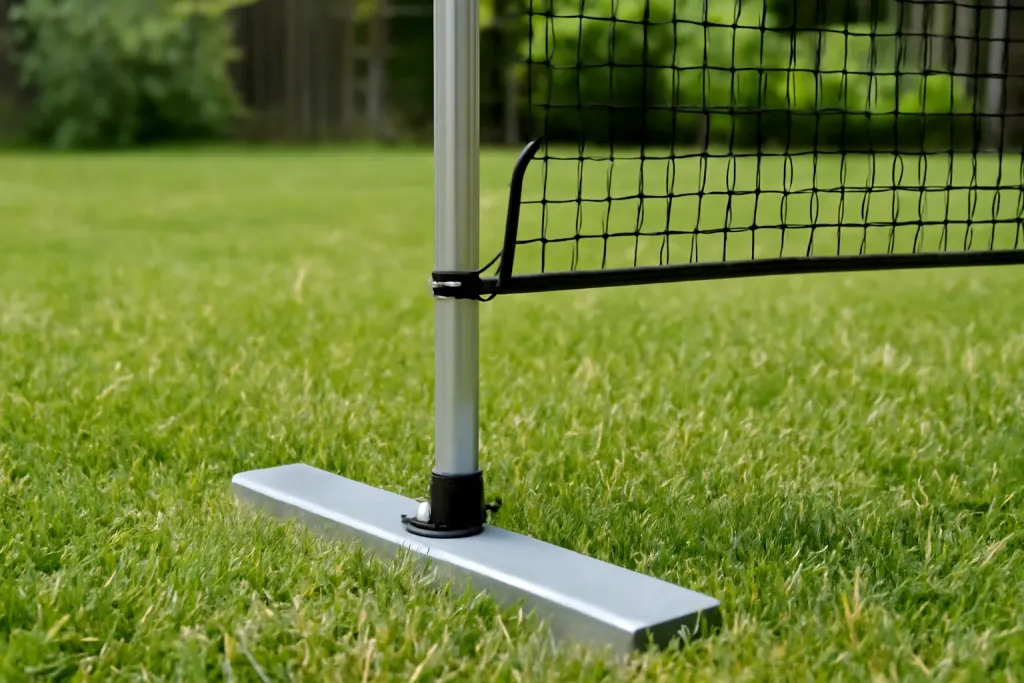
A portable badminton set for backyard use is built around three components — the net, the poles, and the base that anchors those poles into the ground — and the base is usually the part that determines whether the whole setup feels stable during actual play. Unlike a permanent court installation, portable sets need to go up and come down quickly, work on uneven grass, and survive being packed away between uses. This guide breaks down what to look at in each of the three components so you can match a set to your yard and how often you'll use it.
None of this requires official court equipment. Most backyard badminton is casual, and a well-chosen portable set will hold up fine for recreational rallies without needing tournament-spec hardware.
Net Height: Official vs Backyard
Regulation badminton net height, as used in sanctioned play, is 5 feet 1 inch at the center and slightly higher at the posts. Most portable backyard sets are built to approximate this height, but exact conformance varies by manufacturer and by how the poles are adjusted at setup. For casual backyard games, small deviations from the official height rarely matter — what matters more is that the net height stays consistent across the width of the court so rallies feel fair. If you want a setup closer to regulation height for practice purposes, check that the poles have height markings or an adjustable clip rather than a single fixed loop, since fixed-height poles can vary between brands.
Pole Base Types
The base is what keeps the poles upright under net tension and wind, and portable sets generally use one of three approaches:
- Weighted bases use a heavy molded base (often plastic filled with sand or gravel by the user) for a low-maintenance, reasonably stable footprint. They're bulkier to store but don't rely on the ground itself for stability.
- Stake-anchored bases use ground stakes or pegs driven into the lawn alongside a lighter base or guy lines. These are lighter to carry but require soft, stake-friendly ground and aren't practical on hard-packed dirt, pavement, or sand.
- Water-fillable bases are hollow bases filled with water on site, which saves weight during transport but adds setup and teardown time, and they can shift slightly on uneven or sloped lawns if underfilled.
For a yard with soft, level grass, stake-anchored bases are usually the lightest and easiest option. For yards with harder ground, patios, or driveways nearby, a weighted or water-fillable base that doesn't depend on staking is more reliable.
Net Material and Tension
Net material affects both durability and how the shuttlecock behaves near the tape. Most portable nets use a polyester or nylon mesh with a reinforced top tape; tighter, more evenly woven mesh holds its shape longer and sags less over a season of use. Net tension — how tautly the net pulls between the two poles — matters more than most buyers expect. A net that's too loose will sag in the middle, effectively lowering the playable height at center court and causing shots that would clear a taut net to catch instead. Look for sets with a separate tensioning strap or ratchet rather than relying solely on pole height to pull the net tight, since that gives you an easy way to re-tighten the net as it settles during a session.
Browse our recommended gear
Our featured picks refresh periodically. While we update them, our editorial guides can help you find the right gear.
See our guidesPortability and Setup Time
Portable sets vary widely in how quickly they go from bag to playable court. Telescoping poles that collapse to a compact length, a net that folds or rolls rather than needing to be untangled, and a carrying bag sized to fit everything together are the main features that speed up setup. Sets built around stake anchoring tend to set up fastest on suitable ground since there's no water to carry or sand to pour. Weighted and water-fillable bases add a few extra minutes for filling and emptying but avoid depending on ground conditions, which can be the better tradeoff if you move the set between different play areas.
Ground Surface Considerations
Match the base type to where you'll actually play. Level, soft lawn suits stake-anchored bases well. Uneven or sloped yards benefit from weighted or water-fillable bases since they don't rely on soil holding a stake in place, though you may still need to adjust pole height slightly to account for the slope. Hard surfaces like driveways, patios, or courts rule out stakes entirely and require a weighted base with enough footprint to stay put during play. Whatever the surface, check the area for sprinkler heads, tree roots, or debris before setup, and keep young players clear of pole bases and guy lines during setup and teardown, since unattended stakes and taut lines can be a trip hazard for kids running nearby.
Pairing a Net With Rackets and Shuttles
A net and pole set is only half of a functional backyard badminton setup -- rackets and shuttlecocks matter just as much for how enjoyable casual play actually is. Lighter rackets are generally easier for beginners and younger players to control, while nylon shuttlecocks hold up far better than feather shuttles to the ground contact and mis-hits that are common in casual outdoor play. See our nylon vs feather shuttlecock guide for a fuller comparison.
If a household is buying a net set and rackets for the first time together, prioritizing a slightly lower net height and lighter rackets over official specifications makes the game more approachable for a wider range of ages and skill levels.
Browse our recommended gear
Our featured picks refresh periodically. While we update them, our editorial guides can help you find the right gear.
See our guidesTeardown and Storage Between Sessions
Portable net sets are designed to come down relatively quickly, but how well that works in practice depends on the base type. Stake-anchored bases usually break down fastest; water- or sand-fillable bases take longer since they need to be emptied before the poles are easy to move and store.
Storing the net fabric loosely rolled rather than tightly folded helps it avoid permanent creases that can affect how it hangs on reinstallation. A simple storage bag -- often included with portable sets -- keeps the net, poles, and stakes together rather than scattered across a garage shelf.
Multi-Use Net Setups
Some portable net systems are designed to adjust between badminton and other net games like volleyball, which can be a practical choice for families who want to rotate activities without buying and storing multiple separate net sets. These combo systems typically trade a small amount of net-specific optimization for the flexibility of covering more than one game.
If badminton is likely to be the primary or only net game a household plays, a dedicated badminton set is usually a better fit than a combo system, since it's built around badminton's specific height and tension needs rather than being a compromise across multiple sports. See our backyard equipment for mixed-age families guide for more on choosing between dedicated and combo equipment.
Leveling a Net on an Uneven Lawn
Few backyards are perfectly flat, and a net that's level at one end but sagging or too high at the other makes for an uneven game. Adjustable-height poles help compensate for minor slope, but a lawn with a significant grade is worth avoiding for net placement if a flatter alternative area exists.
For stake-anchored bases on a slight slope, angling the stakes slightly against the direction of pull (rather than straight down) can improve holding power on the downhill side, where tension on the net is more likely to gradually pull a stake loose over a session.
Final Thoughts
Choosing a portable badminton set comes down to matching the base type to your yard, making sure the net has a way to tension properly, and weighing setup speed against stability. None of these details require regulation-level equipment — a well-matched casual set will hold up fine for backyard rallies. For more backyard equipment comparisons, visit our Fitness and Outdoor Recreation hub, and see our guide on nylon vs feather shuttlecocks to round out your setup.