Overview
A good croquet set with a carrying case should be compared on five practical points: how many players it supports, whether the mallets are sized for the people who'll actually use them, how durable the wickets and stakes are, how well the case protects and organizes the pieces, and how much lawn space you have for a casual course. Backyard croquet doesn't require official-length equipment, but matching set size and mallet length to your household makes the difference between a set that gets used regularly and one that sits in the garage. This guide walks through each comparison point.
Player Count: 4 vs 6
Croquet sets are commonly sold in 4-player and 6-player configurations, which mainly differ in the number of mallets and balls included, along with wicket count in some sets. A 4-player set is a reasonable choice for smaller households or when croquet is mostly played casually with two or three people at a time. A 6-player set makes more sense for families that regularly host larger groups or want enough mallets on hand without needing to rotate turns as often. Since mallets are usually the most expensive component, buying a 6-player set only to have two mallets sit unused most of the time is worth considering before paying extra for the larger configuration.
Mallet Length and Weight
Mallet length matters more for comfortable play than most first-time buyers expect. A mallet that's too long for a child forces an awkward, hunched swing, while one that's too short for an adult limits proper stance and control. Many sets include mallets of a single adult-oriented length, which works fine for teens and adults but can be unwieldy for younger kids. If young children will be playing regularly, look for sets that include shorter mallets sized for kids, or consider supplementing an adult set with a separate shorter mallet. Weight is a secondary factor — heavier mallet heads provide more consistent momentum through the swing but require a bit more strength to control, which is another reason a single mallet length and weight doesn't suit every player in a mixed-age household equally well.
Browse our recommended gear
Our featured picks refresh periodically. While we update them, our editorial guides can help you find the right gear.
See our guidesWicket and Stake Materials
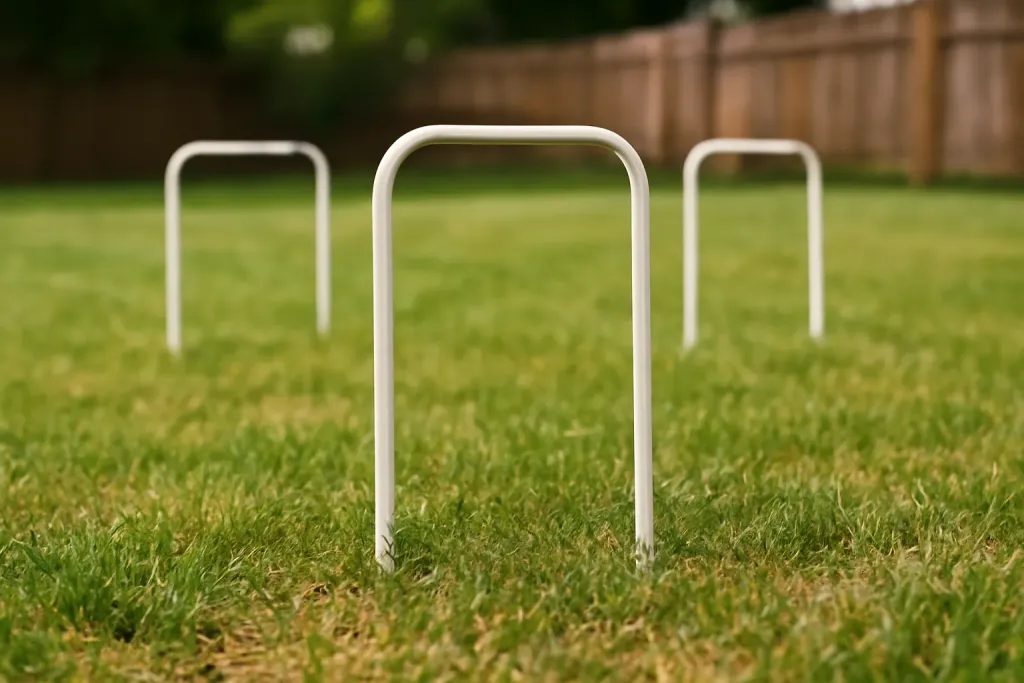
Wickets (the hoops balls are hit through) and stakes (the end markers) are usually made from steel wire or a similar rigid metal, and thickness varies noticeably between budget and sturdier sets. Thin wire wickets bend more easily when struck by a mallet or ball, or when pushed into harder ground, and bent wickets change how a course plays over time. Thicker gauge wire holds its shape better across repeated setup and use. Stakes see less direct impact but still benefit from a sturdy, rust-resistant material if they'll be left outdoors between games or stored in a garage with variable humidity. When comparing sets, a quick way to gauge quality is checking whether the wire flexes noticeably when you press on it by hand — thinner, springier wire is more likely to bend out of shape during play.
Case Quality and What It Should Hold
The carrying case is what keeps a croquet set organized and protected between uses, and case quality varies a lot across sets. A well-designed case should have separate compartments or straps for mallets, balls, wickets, and stakes so pieces don't rattle against each other in transit, along with a sturdy handle and a closure that stays fastened when the case is carried at an angle. Canvas or nylon cases with reinforced stitching tend to hold up better over repeated use than thin fabric cases with minimal structure. Since wickets and stakes are pointed metal pieces, a case with a dedicated padded or sleeved section for them reduces the chance of punctures to the case fabric or scratches to the balls and mallet heads during storage.
Lawn Space for a Casual Course
Official croquet courts are a fairly large, precisely marked rectangle, but backyard play rarely needs anything close to that scale. A casual six-wicket course can be laid out informally in a space roughly the size of a typical backyard, with wicket spacing adjusted to fit whatever open lawn is available. What matters more than exact dimensions is a reasonably flat, obstruction-free surface — tree roots, sprinkler heads, and sloped ground all affect how predictably a ball rolls. If your yard is on the smaller side, a shortened, tighter course layout still works fine for casual games; precise official spacing is really only necessary for formal or competitive play.
Laying Out a Casual Backyard Course
Official croquet courses follow a specific wicket pattern across a large, flat rectangular lawn, but most backyard players simplify this considerably. A shortened, simplified layout -- fewer wickets, a smaller footprint -- works fine for casual family play and takes only a few minutes to set up once the general pattern is understood. The goal for a backyard course is a layout that fits the available lawn without wickets crowding fence lines or garden beds.
Uneven ground, slopes, and thick grass all affect how a ball rolls, so it's worth doing a quick walk of the intended course area before committing to a permanent wicket layout, especially if the set will be left staked out for more than a single afternoon. A slightly shorter course on flatter ground generally plays better than an ambitious layout across uneven terrain.
For mixed-age groups, a shorter course with wider wicket spacing tends to keep younger or less experienced players engaged, while more experienced players can extend the course as skill develops.
Browse our recommended gear
Our featured picks refresh periodically. While we update them, our editorial guides can help you find the right gear.
See our guidesCare and Off-Season Storage
Wooden mallets and stakes benefit from being kept dry between uses -- repeated exposure to rain and damp grass can cause warping or splitting over a season. A carrying case with individual compartments helps here by keeping pieces separated and off wet ground when not in active use, rather than left scattered across the lawn.
Metal wickets generally hold up better to weather than wood, but they're also the pieces most likely to get lost in tall grass if left out after a game. A quick end-of-session count against the case's designated slots is a simple habit that prevents the frustration of starting a game next time with a missing wicket.
Between seasons, a fully dry case stored indoors -- a garage shelf or closet rather than outdoors -- keeps both wood and metal components in better condition for the following year.
Adaptations for Mixed-Age Groups
Croquet's pace and low physical demands make it one of the more naturally mixed-age-friendly backyard games, but a few small adaptations help younger or less coordinated players keep up. Shortening the distance between wickets, allowing a practice shot before the "real" one, or letting younger players use a two-handed grip on the mallet are all common, informal adjustments that don't require any special equipment.
Because a full case typically includes mallets of a single length, families with a wide age range sometimes find that an additional shorter mallet, bought separately, makes the game more comfortable for younger children than making everyone share mallets sized for adults.
These adjustments don't change how the set itself should be evaluated when buying -- case quality, wicket durability, and player count still matter -- but they're worth planning for once the set is in regular use.
Final Thoughts
When comparing croquet sets with carrying cases, match player count to how your household actually plays, check mallet length against who will be swinging them, look for sturdier wicket and stake wire, and favor a case with real organizational structure rather than a simple sack. None of it needs to be regulation-spec for a fun backyard course. For more mixed-age backyard equipment ideas, see our guide on backyard sports equipment for families, or browse the Sport-Specific Buying Guides hub.