Overview
A portable practice kit for volunteer coaches and PE teachers is a compact, transportable collection of the basics needed to run a session: cones, balls, a whistle, a clipboard, and a pump, all packed in a bag that can move easily between a car and a field or gym. Volunteers and teachers frequently don't have dedicated storage at their practice site, so the gear needs to travel with them each session, which shapes what's worth carrying and how it should be packed.
This guide covers what a general-purpose kit typically includes, how to think about transport when you don't have on-site storage, tips for packing a rolling bag efficiently, a reasonable starting budget for a first season, and how to expand the kit as your program's needs grow. Whether you're a parent volunteering to coach a rec league team for the first time or a PE teacher covering several different classes in a day, the same basic kit-building approach applies.
What a General-Purpose Kit Includes
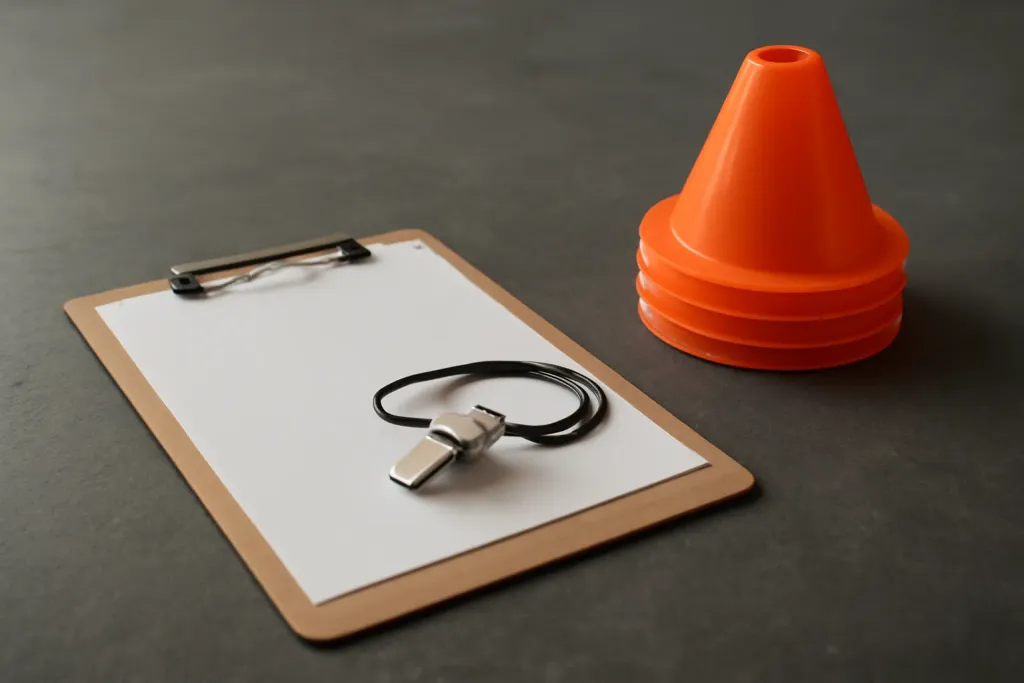
Most portable practice kits build around a small set of versatile items: a set of cones for marking boundaries and drill stations, several balls sized for the sport or activity, a whistle for signaling, a clipboard for rosters and drill notes, and a hand pump with the right needle for keeping balls inflated. This core combination covers a wide range of activities, from soccer and basketball drills to general PE stations, without requiring sport-specific gear right away.
Depending on the group, some coaches also add a first-aid kit, a set of pinnies or vests for team scrimmages, and a bag of extra balls in case one goes flat or over a fence mid-session. Keeping the list focused on genuinely reusable items, rather than one-off gear for a single drill, keeps the kit manageable to carry and maintain.
A small selection of cone colors is also worth having on hand, since different colors let you mark out multiple drill zones at once without players confusing one station's boundary with another's. Similarly, having balls in a couple of sizes, when the group spans a wider age range, saves you from needing to swap gear between activities mid-session.
Transport Without Dedicated Storage
Many volunteer coaches and PE teachers don't have a locker, shed, or closet at their practice field or gym, which means the full kit needs to travel in a car and back out again every session. A single bag or rolling case that holds everything is far more practical than several loose items, since it reduces the chance of leaving something behind and makes loading and unloading faster before and after practice.
If you're coaching at multiple locations or sharing gear with another volunteer, a kit that's easy to hand off, with everything accounted for in one place, avoids the confusion of partial bags scattered across different cars or closets. Labeling the bag and doing a quick item count at the end of each session helps catch anything left on the field before it's lost.
For teachers moving between several classes or fields in a single day, a bag light enough to carry comfortably across a school campus matters as much as overall capacity. A bag that's technically roomy but awkward to wheel across grass or up stairs ends up being a hassle rather than a convenience, so it's worth considering the actual walking routes at your site before choosing a larger case.
Browse our recommended gear
Our featured picks refresh periodically. While we update them, our editorial guides can help you find the right gear.
See our guidesPacking and Organizing a Rolling Bag
A rolling equipment bag with a wide opening and internal compartments makes packing and unpacking noticeably faster than a single large duffel. Grouping similar items, such as keeping all cones in one mesh pocket and balls in another, means you can grab exactly what you need for a specific drill without emptying the whole bag onto the ground.
Packing heavier items like the pump and clipboard near the base of the bag, with lighter items like cones and pinnies on top, keeps the bag more stable when rolling it across a parking lot or field. A separate small pouch for the whistle, lanyard, and any loose small items prevents them from getting buried under bulkier gear. For gear focused specifically on officiating and timing, see our guide to referee whistles, clipboards, timers, and starter kits.
A Budget-Conscious Starting Point
For a first season, it's reasonable to start with a modest kit rather than buying every possible accessory upfront. A basic set of cones, a handful of balls appropriate for the group's age and sport, a whistle, a clipboard, and a pump cover the essentials for most practices and PE classes without a large initial cost. Many volunteers find that this starting kit handles the bulk of what they need for months before any gaps become obvious.
Buying gear incrementally, based on what a season actually reveals you need, tends to be more cost-effective than assembling a large kit before you know your group's specific requirements. Watching what other coaches or teachers at your site use, and asking what's actually gotten regular use versus what sat unused, is a practical way to guide future purchases.
Borrowing or sharing lightly used gear with another volunteer, at least for a first season, is another reasonable way to spread out the initial cost while you figure out exactly what your group needs on a regular basis.
Expanding the Kit as Needs Grow
As a program grows or takes on new activities, the kit can expand accordingly. Adding sport-specific items, like agility ladders for footwork drills or a rebounder net for solo practice stations, is a natural next step once the basics are well established. Similarly, a group working with mixed ages or skill levels might add extra sets of cones or balls to run multiple stations at once rather than having everyone share one drill area.
Adult supervision and appropriate spacing between activity stations remain important as a kit and program grow, particularly with younger participants moving between different drills. Keeping the core kit organized even as it expands, rather than letting extra gear pile up loosely, keeps transport and setup manageable. Our guide to youth agility ladders and cone sets is a useful next step for expanding footwork and coordination drills.
Labeling Loaner and Shared Gear
Equipment that gets handed out to a group of kids during practice has a way of not making it back into the bag. A simple label -- team name, initials, or a colored tape marker -- on cones, balls, and other loaner gear makes it easier to track down stray pieces at the end of a session and reduces the chance of gradually losing a full set over a season.
For volunteers managing shared gear across multiple practice groups, a basic sign-out habit (even an informal headcount before and after) catches missing items while they're still easy to recover, rather than discovering a shortfall weeks later.
Browse our recommended gear
Our featured picks refresh periodically. While we update them, our editorial guides can help you find the right gear.
See our guidesA Seasonal Equipment Refresh Check
Before each new season, a quick check of the kit -- inflated balls, working whistle, intact cones, a clean clipboard -- catches problems before the first practice rather than mid-session. Items that see heavy handling by kids, like cones and pinnies, tend to need replacing more often than sturdier gear like a clipboard or pump.
This is also a reasonable time to reassess whether the kit still matches the group's needs -- a volunteer coaching a larger group than last season, for example, may need more cones or a second ball bag rather than assuming the original kit still covers everyone.
Sharing Gear Across Multiple Groups
Volunteers who help with more than one practice group or team in a week face a slightly different challenge than a single-team coach -- gear needs to be quickly identifiable and easy to hand off if another volunteer is using it on a different day. Keeping the kit in one dedicated, clearly labeled bag rather than mixed in with personal items makes handoffs between volunteers simpler.
A quick shared checklist -- what should be in the bag before it's passed to the next person -- helps prevent the slow item-by-item attrition that happens when gear is shared across multiple people without a clear system.
For programs with several volunteers rotating through practices, having two or three duplicate basic kits (rather than one kit everyone shares) often works out to be simpler in practice than a strict handoff schedule.
Final Thoughts
A well-organized portable practice kit gives volunteer coaches and PE teachers a reliable, transportable foundation for running sessions without needing on-site storage. Starting with the core basics, packing them efficiently in a rolling bag, and expanding gradually as your program's needs become clearer is a practical, budget-conscious way to build out a kit over time.
Most volunteers find that the kit which felt like plenty in the first few weeks needs small adjustments as a season goes on, and that's a normal part of settling into a coaching or teaching role rather than a sign anything was planned poorly. Visit our Sports Equipment hub for more gear to round out your setup.