Overview
A portable table-tennis net and post set is a clamp-mounted net assembly that attaches to the edge of any suitable flat table, turning it into a temporary table-tennis surface without a dedicated table. These sets are popular for dining tables, break rooms, garages, and rec centers where a full-size table-tennis table isn't practical or affordable. Because the net and posts pack down small and travel easily, they're a common pick for casual players who want occasional games rather than a permanent setup.
The core components are two posts with clamping jaws, a net that stretches between them, and sometimes a small tensioning screw or cord to keep the net taut. Setup usually takes under a minute once you know your table's edge thickness and shape. This guide walks through how the clamps work, what table styles are compatible, how net height and tension compare to regulation table-tennis tables, how to avoid marking your table, and how to store the set between uses.
How Clamp-Style Sets Work
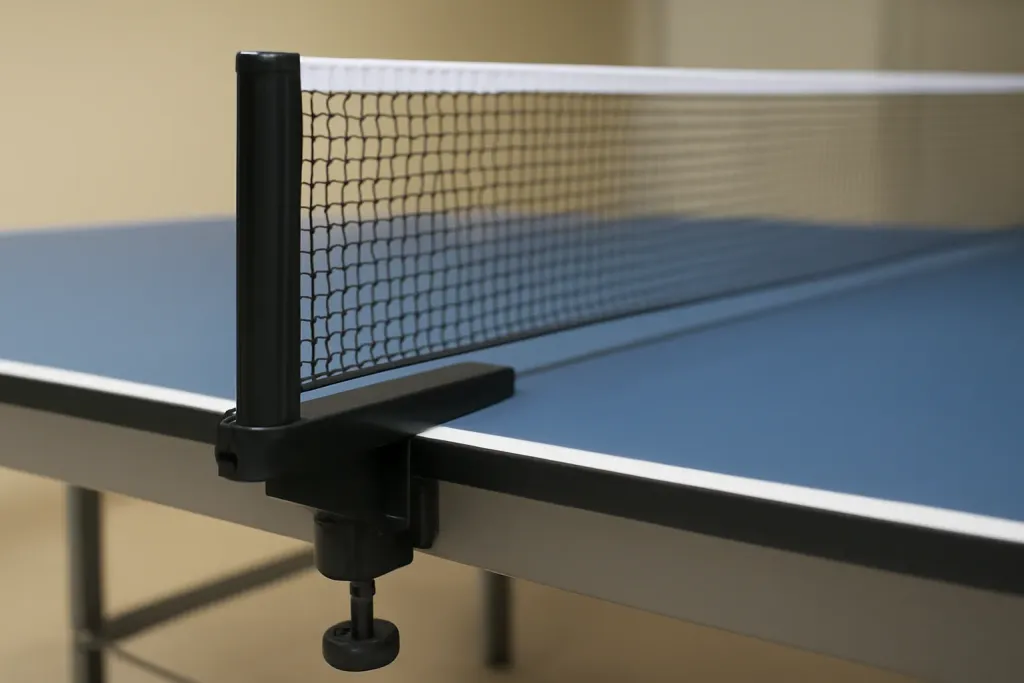
Most portable net sets use a screw-tightened clamp or a spring-loaded jaw that grips the tabletop from above and below. Turning a knob draws the jaw tight against the table edge, holding the post upright under the tension of the net. Because the net pulls the posts inward toward each other, a properly tightened clamp resists slipping during normal play, though it isn't designed to withstand leaning on the post or repeated impacts.
Some sets add a rubber or foam pad on the clamp's contact points to improve grip and reduce marking. Others rely on a wide, flat clamping surface rather than a pad. Either way, the clamp needs firm, even contact across the table edge to hold the net at consistent tension, so it helps to tighten gradually on both posts rather than fully tightening one side first.
Most posts are made from lightweight aluminum or coated steel tubing, which keeps the overall set light enough to carry in a small bag while still holding up to the sideways tension the net puts on them during play. A wider base plate at the clamp generally distributes pressure more evenly across the table edge than a narrow, single-point clamp, which can reduce the risk of the post shifting mid-game if the table gets bumped.
Table Thickness and Edge Compatibility
Clamp jaws are sized for a range of table thicknesses, typically covering thin folding tables up to thicker dining or conference tables. Checking the stated clamp opening range before buying helps you avoid a set that's either too loose to grip a thin edge or too narrow to close around a thick one. A table edge that's rounded, beveled, or has trim molding can also affect how firmly a clamp seats, since the jaw generally works best against a flat, parallel edge.
Glass tables and tables with delicate finishes deserve extra caution, since clamp pressure can occasionally mark soft veneers or stress glass edges. If you're testing a net set on a table you don't want to risk, it's worth clamping gently first and checking for any shift or stress before applying full tension.
It's also worth considering the table's overall stability once a net and posts are attached. A lightweight folding table can shift or wobble more than a solid dining table when players lean in to reach a shot, so checking that the table's legs are locked and the surface is on level ground helps keep the whole setup steady during a game. Tables with a center seam, like some folding models, can also create a slight gap that changes how the ball bounces near the middle, which is worth knowing about ahead of time rather than during a rally.
Net Height and Tension
Regulation table-tennis tables use a net height of about 6 inches (15.25 cm) measured from the playing surface, with the net's top edge parallel to the table and its ends touching the posts along their full height. Portable clamp-on sets generally aim to replicate this height, but because they're mounted on a table that wasn't built to table-tennis specifications, exact height and tension can vary slightly from a dedicated table-tennis table.
For casual, recreational play this difference rarely matters. If you want a closer approximation of regulation conditions, look for a set with an adjustable post height and a tensioning mechanism, and check that the net sits evenly across the table's width without sagging in the middle. A net that's too loose changes how the ball rebounds off it, which can be a fun quirk in casual games but worth knowing about if you're practicing specific shots.
Net material also plays a role in how it performs. Most portable nets use a lightweight woven mesh, similar to what's found on standard table-tennis tables, though some budget sets use a slightly heavier fabric that can dampen the ball's bounce more than a regulation net would. If you're mainly using the set for casual family games rather than focused practice, this difference is unlikely to affect how much fun the games are, but competitive players may notice the change in feel compared with a club or regulation table.
Protecting Your Table
Because clamps grip both the top and underside of a table edge, it's worth inspecting the contact points before and after each use, especially on painted, laminate, or wood-veneer surfaces. A soft cloth or a small piece of felt placed between the clamp and the table can add a layer of protection on finishes you're concerned about, and many players keep a folded towel handy for exactly this purpose.
Tightening the clamp just enough to hold the net taut, rather than as hard as it will go, reduces the chance of denting or scuffing the surface. If you're setting the net up on a shared or rented table, it's good etiquette to check with whoever's responsible for the furniture first, since not every table is meant to take clamp pressure.
After play, wiping down the clamp area and checking that no debris got trapped underneath during setup helps prevent scratches the next time you attach the net. If you notice any looseness or a slightly bent jaw after repeated use, it's worth addressing before your next session rather than continuing to clamp down harder to compensate, since forcing a worn clamp can increase the chance of marking the table.
Browse our recommended gear
Our featured picks refresh periodically. While we update them, our editorial guides can help you find the right gear.
See our guidesStorage and Portability
One of the main appeals of a clamp-on net set is how little space it takes up compared with a folding table-tennis table. Posts typically collapse or come apart from the net for flat storage, and the whole set often fits in a bag small enough for a closet shelf or a car trunk. This makes it a practical option for households without room for a full table, or for community spaces that need to set up and break down quickly between other uses.
If you're moving the set between locations often, a set with a rigid carrying case or pouch will hold up better than loose parts rattling around a bag. Storing the net loosely coiled, rather than tightly wound, also helps it keep its shape and lie flat the next time you set it up. For related gear like paddles, see our guide to table-tennis paddles for recreational players.
For families or shared spaces juggling several types of games, a portable net set pairs naturally with other easy-storage equipment, since none of it requires a dedicated room or permanent fixture. Keeping the net set, paddles, and balls together in one bag, rather than scattered across different storage spots, makes it far more likely the set actually gets used on a whim rather than left forgotten in a closet.
Using a Clamp Net in Shared or Rented Spaces
Clamp-style nets are popular precisely because they don't require a dedicated table-tennis table, but that also means they're often used on shared or rented furniture where marks or scratches matter. Testing the clamp on an inconspicuous edge first, and adding a thin cloth or felt pad between the clamp and the table surface, reduces the chance of visible marks on finished wood.
In shared households, agreeing on which table is available for net use (and confirming it's sturdy enough to handle clamp pressure and ball impact) avoids damaging furniture that wasn't meant to double as a game table.
Pairing a Net Set With Paddles and Balls
A net and post set is only useful with a reasonable pair of paddles and balls to go with it. For casual home play, a basic recreational paddle set and a few standard balls are enough to get started -- see our table-tennis paddle guide for more on choosing a set that matches casual play rather than club-level equipment.
Because balls tend to roll off tables and get lost or stepped on, buying a few extras beyond what comes with the net set is a practical habit for households with kids or pets nearby.
Final Thoughts
A portable table-tennis net and post set is a low-commitment way to add casual play to almost any flat table, as long as you match the clamp range to your table's thickness and take basic care of the surface. It won't fully replicate a dedicated table-tennis table, but for family game nights, office breaks, or shared community spaces, that's rarely the point. Browse our Training Accessories hub for more portable practice gear that packs down small.