Overview
The main decision when buying a backyard tetherball set is whether to install a permanent in-ground pole or use a portable set with a weighted base — permanent poles offer the most stability for regular, energetic play, while portable bases let you move or store the set when it's not in use. Beyond that choice, pole height, rope length, and clear space around the pole are the details that determine whether the set feels safe and fun rather than cramped or wobbly.
Tetherball is a simple game, but a poorly installed pole is one of the more common sources of backyard frustration — either it tips during active play or it's permanently in the way of mowing and other yard use. Thinking through installation before buying saves a return trip to the store.
Unlike many backyard games that pack up between uses, a tetherball pole is typically a semi-permanent fixture — either literally cemented into the yard or set up in a consistent spot for a season at a time. That makes the initial installation decision more consequential than with, say, a set of horseshoe stakes that can simply be pulled up and moved. Taking a few extra minutes to plan pole location, height, and anchoring pays off in fewer headaches later.
Permanent vs portable pole systems
Permanent poles are set into a concrete footing in the ground, similar to a mailbox post. This gives the sturdiest possible base, which matters because tetherball involves fast, repeated impacts against the pole as the ball wraps around it. A well-set permanent pole won't wobble or lean over time, and it's the closer match to how tetherball poles are installed at schools and parks.
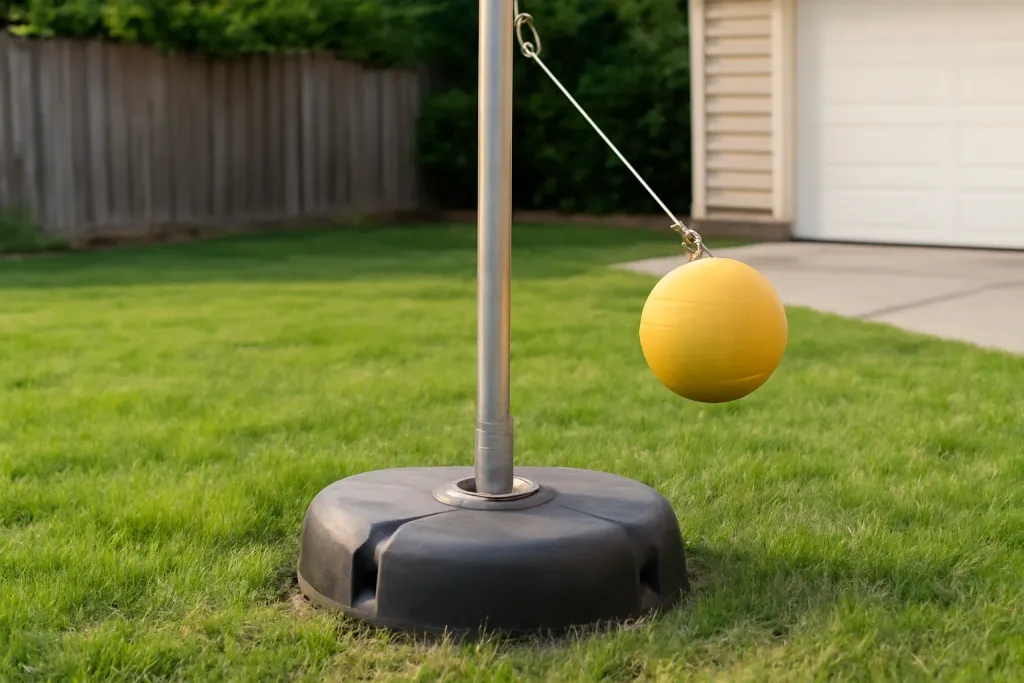
Portable sets use a weighted or fillable base — often sand or water — that sits on top of the ground rather than being anchored into it. These are easier to install (no digging or concrete needed) and can be moved or stored away, which is useful for renters, families who reconfigure their yard seasonally, or anyone unsure about committing to a permanent structure. The tradeoff is a small amount of base movement during vigorous play, especially on uneven ground, so checking the base weight rating before buying is worthwhile if you have older kids or teens who play hard.
A middle-ground option some households use is a heavy-duty portable base filled with both sand and additional weighted plates, which narrows the stability gap with permanent poles while still allowing the set to be relocated if needed. This can be a reasonable compromise for renters or anyone not ready to commit to a concrete footing but who still wants a sturdier feel than a basic hollow plastic base provides.
Pole height and rope length
Most backyard tetherball poles range from around 8 to 10 feet tall, with some adjustable models that let the rope attachment point move up or down to suit different player heights. A shorter effective height works better for younger kids, while a taller pole gives more room for taller or older players to swing without constantly ducking the rope.
Adjustable poles are worth the modest extra cost for households with a wide age range, since a single set can be reconfigured as kids grow or when adults join a game, rather than needing a completely different pole down the road. Fixed-height poles are simpler and often slightly more budget-friendly, which works fine if the primary players are close in age and height.
Rope length is usually fixed by the manufacturer to match the pole height, so there's less to compare here than with pole type, but it's worth checking that the set includes a durable, weather-resistant rope rather than one that will fray quickly with daily outdoor use.
Ball quality is worth a quick mention alongside the pole itself. Most sets include a rubber or synthetic ball with a built-in rope loop or attachment point, and this attachment is a common failure point over time — repeated hard hits can eventually wear through the connection. If your set will see frequent, energetic use, look for a ball with a reinforced attachment rather than the most basic version, since replacing just the ball is simpler than replacing the whole set but still an avoidable hassle.
Ground clearance and safety spacing
Because players circle the pole while swinging at the ball, tetherball needs more open space around it than its footprint suggests. A general rule of thumb is to keep at least several feet of clear space in every direction from the pole, away from fences, patio furniture, garden beds, and windows. This gives players room to move and reduces the chance of a bumped elbow or a stumble into a hard surface during an energetic match.
It's also worth checking the ground surface itself — grass or a soft play surface is more forgiving underfoot than concrete or pavers if a player trips while spinning around the pole.
It's also worth thinking about sightlines and traffic patterns in the yard. Placing a pole where household members regularly walk — near a side gate, a garden path, or a driveway — creates an ongoing tripping and collision risk even when no one is actively playing. A spot slightly off the main walking paths, with clear visibility from the house, tends to work best for both safety and convenience.
Pole placement relative to neighboring yards is also worth a moment's thought if you share a fence line. A pole set close to the boundary can occasionally send a ball or a wide swing toward a neighbor's side, so leaving a comfortable buffer from property lines, alongside the usual clearance from fixed objects, tends to mean fewer awkward retrieval trips over the fence.
Supervision for younger kids
Tetherball can be played by a wide age range, but younger children playing with older kids or adults should generally be supervised, since the ball moves quickly and a strong serve from a bigger player can be surprising for a smaller one. Choosing a slightly shorter pole height or a softer ball for mixed-age groups can help even out the game. For more general guidance on selecting gear that works across different ages in one household, see our guide to backyard sports equipment for families with mixed ages.
Establishing a few basic ground rules before the first game also helps, especially with a group of kids of different ages and strengths — things like taking turns serving, avoiding wind-up swings aimed at a much smaller player, and pausing play if someone needs to step in close to untangle the rope. These are simple habits rather than formal rules, but they go a long way toward keeping tetherball fun rather than intimidating for younger or less experienced players.
Browse our recommended gear
Our featured picks refresh periodically. While we update them, our editorial guides can help you find the right gear.
See our guidesSeasonal takedown and storage
Portable base sets have an advantage at the end of a season or during severe weather: the pole can typically be removed, the base emptied of sand or water, and everything stored in a garage or shed until next use. Permanent in-ground poles stay in place year-round, For a permanent pole in a region with harsh winters, it's worth checking whether the manufacturer suggests any seasonal steps, such as removing the ball and rope during long stretches of freezing weather. Even without full disassembly, giving the base and pole a quick inspection each spring for rust, cracking, or loosened hardware helps catch small issues before they turn into bigger repairs. It's also worth considering local winter weather when choosing pole material — some are more resistant to rust or UV fading than others.
If you're setting up a broader system for keeping yard game equipment organized between uses, our Storage Solutions hub covers racks, bins, and carts that work well alongside larger gear like tetherball poles.
Rope and Ball Maintenance
The rope connecting the ball to the pole is usually the first part of a tetherball set to show wear, since it takes repeated friction against the pole with every hit. Checking the rope periodically for fraying, and replacing it before it snaps mid-game, is a simple maintenance habit that keeps the set safe and usable.
The ball itself benefits from being brought in during extended bad weather if it's not a weather-rated outdoor ball, since prolonged sun and rain exposure can degrade the cover material faster than normal play does.
Ground Surface Considerations
Tetherball is typically played on a hard, flat surface -- a driveway or patio -- rather than grass, since consistent footing matters for the quick lateral movement the game involves. A grass installation can still work for casual family play, but expect less predictable footing, especially after rain.
If installing on a hard surface, double-check that the base (whether staked, weighted, or set in concrete) won't shift under repeated lateral force, since a tetherball pole takes more sideways stress over a game than most other backyard equipment.
Final thoughts
A backyard tetherball set is a straightforward purchase once you decide between a permanent, in-ground pole and a portable weighted-base model. Permanent poles give the sturdiest play experience for regular use, while portable sets offer flexibility for smaller yards or seasonal storage. Whichever you choose, giving the pole enough clear space and keeping an eye on younger or mixed-age players will make for a safer, more enjoyable game.
Before finalizing a spot in the yard, it's worth walking through the full circle of motion a player would make around the pole and double-checking that nothing — a low branch, a sprinkler head, an outdoor light fixture — sits within that swing radius. This kind of quick walkthrough, done once during setup, is a simple way to catch hazards that aren't obvious from a quick glance at the yard.