Youth Football · Updated November 3, 2026 ·
By Editorial Team
Youth Football Cleats: How to Choose the Right Pair
Quick answer
Quick answer
For most first-year players, pick the cut by position, choose molded studs unless the field is often wet and your league allows detachable ones, and buy the size that fits now with a quarter inch of toe room and game socks on. Check your league's cleat rules before you buy.
Youth football cleats are the one piece of gear most families buy themselves, so it is worth getting right. A good pair does three things: it grips the field when your child cuts or accelerates, it holds the foot firmly so the heel does not slip, and it fits today's foot. This guide covers the choices in the order you will face them: the cut, the studs, the fit, then the rules.
Everything below that comes from a maker or retailer guide is named and linked in the sources line at the end of each section. We have not tested cleats, and we do not rank them. We explain what to look for so you can choose from any brand's range.
What is in a football cleat
DICK'S Sporting Goods lists five parts of a football cleat. Knowing them makes size charts and product pages easier to read.
Parts of a football cleat
Part
What it does
Upper
The laces or straps and the material around the foot; usually durable synthetic material
Midsole
Cushioning between the upper and the outsole
Outsole
The base, usually molded rubber or plastic, which gives stability and balance
Studs
Projections on the outsole that give traction for cutting, accelerating and stopping
Heel counter
A stiffer cup at the back that keeps the heel stable
When you compare two pairs, the parts that change most are the cut of the upper and the type of studs. The rest is mostly about fit and comfort, which you can only judge on the foot.
Football cleats come in three cuts, named for how high the upper rises around the ankle. DICK'S Sporting Goods ties each to the kind of play it suits: low-cut for speed and quick changes of direction (wide receivers and defensive backs often choose them), mid-top for a balance of mobility and ankle support (linebackers and running backs), and high-cut for the most ankle support (linemen and taller players).
Football cleat cuts compared
Cut
What it favors
Often chosen by
Low
Lightest feel, most freedom of movement
Receivers and defensive backs
Mid
A balance of movement and ankle support
Linebackers and running backs
High
Most ankle support
Linemen and taller players
Treat those as the retailer's typical pairings, not rules. A young player who has not settled into a position does not need to guess; a mid-top is a reasonable middle choice, and the best test is how your child moves in them. Ask your coach if a position-specific cut matters on your team.
Whichever cut you choose, we make no claim that a cut protects against a particular injury; the guide we read does not offer one that we could check.
Molded or detachable studs
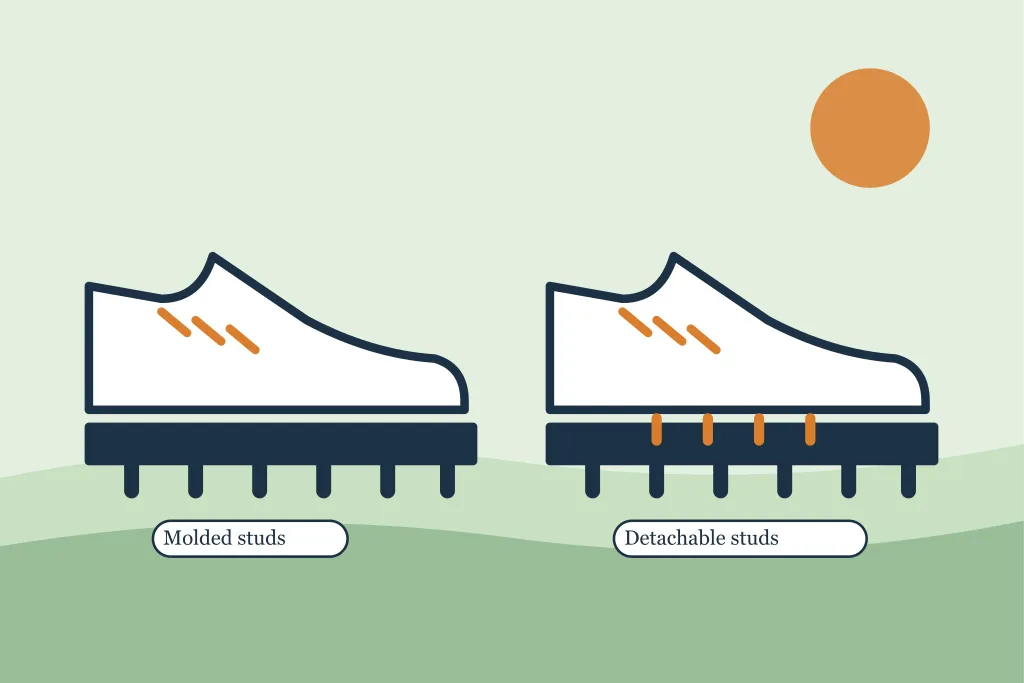
The second choice is how the studs attach. Molded cleats have studs permanently part of the sole. Detachable cleats have replaceable studs that can be swapped for conditions. DICK'S says molded cleats tend to need less maintenance and work across different surfaces, and that detachable cleats suit changing weather: shorter studs for dry, firm ground and longer studs for wet or soft fields.
Molded and detachable studs compared
Molded
Detachable
Studs
Permanently attached
Replaceable; swap by field
Upkeep
Tends to need less
Needs the right replacement studs for the shoe; check they are fitted properly
Best for
Most first-year players and mixed surfaces
Players who often face wet or soft fields
League rules
Check your league; some require or restrict by type
The last row is the one that decides most families' choice. DICK'S says youth leagues may restrict cleat types, so check your league's regulations before you buy. If you cannot find a written rule, ask the coach, and if you are choosing detachable cleats, ask whether metal or long studs are allowed.
If your child plays flag football, ask the league before buying a tackle cleat at all: stud rules can differ.
This is where most youth cleats go wrong. DICK'S advises never buying cleats that are too big in the hope a child will grow into them, and says oversized cleats can affect performance and increase the risk of injury. The cleats should feel snug but not uncomfortably tight. Use these steps at home or in a store:
1
Measure the foot
Stand your child on a sheet of paper and mark the longest toe and the heel. Measure the distance with a ruler or tape. Read the brand's size chart, since sizing varies by maker.
2
Wear game socks
Football socks add bulk. Try the cleats on with the socks your child will wear in games.
3
Leave a quarter inch
Aim for about a quarter inch between the longest toe and the front of the cleat, so toes are not cramped.
4
Check the heel
The heel should stay in place when your child walks and jogs. A slipping heel is a fit problem, not something to fix with a thicker sock.
5
Break them in at practice
Wear the cleats at practices or light training before game day so they mold to the foot.
If one brand feels too narrow or loose, try another: DICK'S notes that sizing varies between manufacturers. Never rely on shoe size alone; football cleat sizes are not always the same as everyday shoe sizes.
League rules decide which cleats are allowed, and we have not found a single official page that sets the rule for all youth football. That is why we send you to your own league. Ask three questions before you buy:
Sizes and ranges here are makers' and leagues' published guidance, not a measurement of your child. Kids grow at different rates: check fit in person and follow your league's equipment rules.
Common mistakes and fixes
Common cleat mistakes and what to do instead
Mistake
Fix
Buying a size up to grow into
Buy for today's foot; recheck at the next growth spurt
Trying them on without game socks
Bring the socks and try the cleats with them on
Choosing detachable studs without checking the rules
Ask your league before you buy
Assuming shoe size equals cleat size
Measure the foot and read the brand's chart
Skipping the break-in
Wear them at practice first, not for the first time on game day
Using the same pair after the grip fades
Replace cleats when traction drops or the foot hurts
DICK'S says cleats lose traction and comfort as they wear, and that reduced grip or foot pain is the time to replace them. For a child that usually shows up at one of two moments: the toes touch the front, or the studs have worn down. If your child has outgrown the cleats in the middle of a season, that is a fit problem, not a style problem.
Measure foot length, then read the brand's size chart. DICK'S advises about a quarter inch of toe room and trying cleats on with game socks. Sizes vary by brand, so use the chart for the pair you are buying.
Is football cleat size the same as shoe size?
Not always. Cleat sizing varies between makers, so measure the foot and check the brand's own chart. If one brand fits poorly, try another.
Should I size up or down for football cleats?
Neither. Buy the size that fits today: snug but not tight, with about a quarter inch at the toe. DICK'S says oversized cleats can affect performance and increase the risk of injury, so do not buy a size up to grow into them.
Should kids size up in cleats?
No. Buying a larger size for growth leaves the foot sliding. Recheck the fit at the next growth spurt and replace the pair when it no longer fits.
How do I choose football cleats for my child?
Pick the cut by position (low, mid or high), the studs by field and league rules (molded or detachable), and the size by foot length. Then check your league's cleat rules before you buy.
Are molded or detachable cleats better for youth football?
Molded cleats tend to need less upkeep and suit most first-year players. Detachable cleats let you change stud length for wet or dry fields. Some youth leagues restrict cleat types, so check the rules first.
This article reflects independent editorial research and disclosed buying criteria. This is not medical, coaching, or professional safety advice.
Some links on this page are Amazon Associates affiliate links; see our
affiliate disclosure for details.