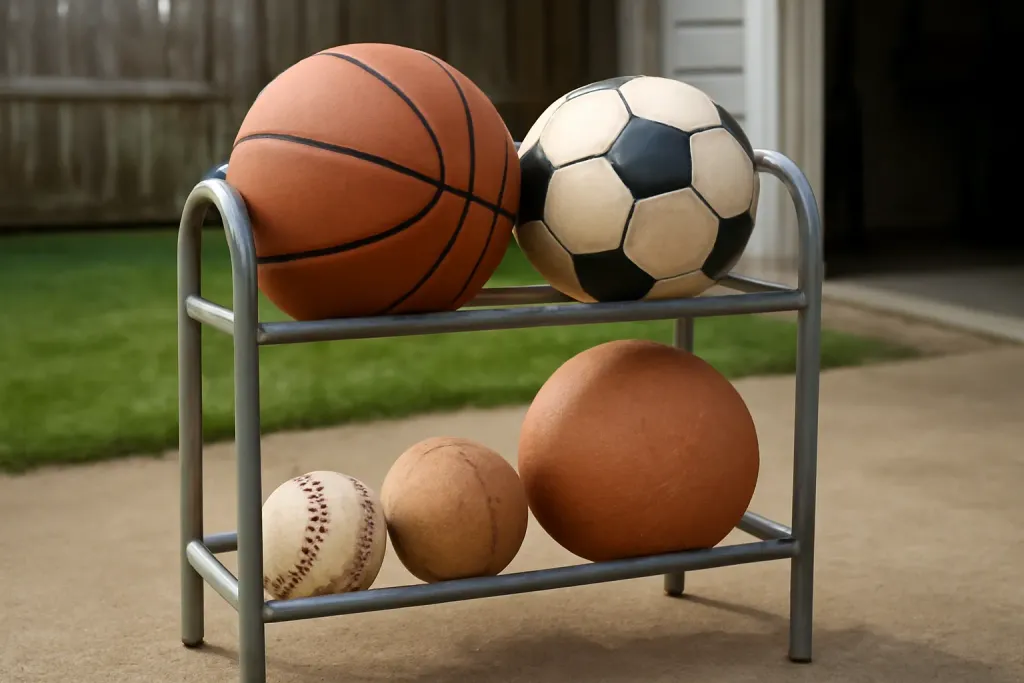
Overview
Wall-mounted racks, door hooks, bins, and rolling carts each solve the sports-ball storage problem differently: racks and hooks keep balls visible and off the floor without drilling into a wall (in the case of hooks) or with minimal mounting hardware (racks), bins group loose balls together for easy scooping, and rolling carts add mobility for households that transport gear frequently. There's no single best option — the right pick depends on your space, how many balls you're storing, and whether you rent or own your home.
Most households eventually end up using more than one of these together rather than picking just one, since each option covers a slightly different need.
This guide compares the four options directly, then walks through which combination tends to fit different household situations, so you can build a system that matches how your family actually plays and travels with gear rather than guessing based on price or appearance alone.
Side-by-side comparison
A wall-mounted rack typically uses shaped cutouts or prongs to hold balls of various sizes in place against a wall, keeping them visible and easy to grab. It usually requires drilling into wall studs for a secure mount, especially if it will hold heavier balls like basketballs or soccer balls.
Door or over-the-door hooks avoid drilling entirely, hanging mesh bags or hook systems over an existing door. They're a good lower-commitment option but generally hold less weight and fewer balls than a full wall rack, and they can make the door harder to close fully if overloaded.
Bins are the simplest option: a container, sometimes with a lid, that groups balls together without individual slots. They're inexpensive and flexible in size but don't keep balls visually organized the way a rack does — everything gets tossed in together unless bins are further divided by type.
Rolling carts combine some rack- or bin-like storage with wheels, letting the whole unit move from garage to car or across a yard. They tend to be the most expensive option and take up more floor space, but they're the only one of the four built for mobility rather than just storage.
Beyond these four core categories, some households also use simple mesh ball bags with a drawstring closure, which act as a hybrid between a bin and a hook — the bag itself can be hung on a hook or set on a shelf, giving a bit of the flexibility of both approaches in one inexpensive accessory. These work especially well for a single sport's worth of balls that need to travel together as a set.
Which fits your household
Renters or anyone who can't or doesn't want to drill into walls will likely lean toward bins or door hooks, since both avoid permanent installation. Coaches or parents who regularly transport gear to practices and games benefit most from a rolling cart, since it turns a pile of loose balls into one wheeled unit that's easy to load and unload. Families with a large, mixed collection of balls — basketballs, soccer balls, footballs, and smaller balls like tennis or baseballs — often do best with a wall rack for the bigger items and a bin for smaller ones, since a single rack rarely fits every ball size well.
If you're setting up storage for a wider range of gear beyond just balls, our broader guide to garage sports-equipment storage ideas covers racks, shelving, and vertical space together.
Households with young kids who are learning to put away their own gear often benefit from lower, simpler storage — a floor-level bin or a low-mounted hook within a child's reach — even if it's not the most space-efficient option, since a system that's actually used consistently beats a more elegant one that only adults can manage. As kids get older and gear collections grow, transitioning to a wall rack or a shared family bin system tends to make more sense.
Browse our recommended gear
Our featured picks refresh periodically. While we update them, our editorial guides can help you find the right gear.
See our guidesCost and installation effort
Bins are typically the least expensive and require no installation beyond finding floor or shelf space. Door hooks are similarly low-cost and low-effort, needing at most a few minutes to hang. Wall racks cost more and require finding studs and using a drill, but the payoff is a sturdier, more permanent storage solution that can hold heavier balls securely. Rolling carts sit at the higher end of the cost range given the wheels and frame construction, but they need no installation at all — just assembly out of the box in most cases.
Cost differences narrow somewhat when you factor in longevity. A well-built wall rack can last many years without needing replacement, while cheaper bins sometimes crack or lose their shape after repeated outdoor exposure and need replacing sooner. Weighing upfront cost against expected lifespan gives a more accurate picture of long-term value than comparing sticker prices alone.
Mixing storage types
Most well-organized garages or sport closets end up combining two or more of these approaches rather than relying on just one. A common setup is a wall rack for larger balls that get used often, a labeled bin for smaller accessories or off-season balls, and a rolling cart reserved for game-day gear that needs to travel. Thinking of these as complementary tools rather than competing options makes it easier to build a system that actually fits how your household uses its gear, rather than forcing everything into a single storage type.
A simple way to start mixing types without overcommitting is to add one new storage element at a time and observe how the household actually uses it for a few weeks before buying the next piece. This avoids ending up with an expensive combination of racks, bins, and a cart that don't quite match how gear actually moves through the house on a typical day.
Installation Time and Tools Needed
Installation effort varies more than the price tags might suggest. A wall-mounted rack typically needs a stud finder, a drill, and about 20-30 minutes, plus a wall that can actually support the mounting hardware -- drywall alone usually isn't enough for a loaded rack. Door-mounted hooks and freestanding bins, by contrast, need no tools at all and can be set up in a couple of minutes, which matters for renters or anyone who isn't ready to commit to a permanent wall fixture.
Rolling carts fall in the middle: no wall mounting is required, but larger carts often arrive partially unassembled, so budget some assembly time before the first use. If a household is still deciding between storage types, starting with a no-tools option like a bin or door hooks is a low-commitment way to see how much gear actually needs a permanent home before drilling into a wall.
Whichever type is chosen, double-check any stated weight limit against a realistic estimate of what will actually go on it -- a rack rated for a handful of light balls will sag or fail well before it reaches its limit if loaded with heavier equipment like bats or weighted training balls.
Planning for Capacity Growth
Most households underestimate how much sports equipment they'll accumulate a year or two after the first purchase. A rack or bin that comfortably holds today's gear can feel undersized once a second sport or a second kid's worth of equipment enters the picture. Buying slightly more capacity than currently needed, or choosing a modular system that can be added to later, tends to save a second purchase down the line.
Rolling carts and open shelving units are generally the easiest to expand incrementally, since additional shelves or a second cart can be added without redoing the original installation. Wall-mounted racks and door hooks are more fixed once installed, so it's worth thinking one season ahead rather than sizing strictly to what's on hand right now.
If capacity is genuinely uncertain, a mixed approach -- a fixed rack for the core, frequently used items plus a flexible bin for whatever doesn't have an obvious permanent spot yet -- is a reasonable way to avoid over-committing to one storage type too early.
Browse our recommended gear
Our featured picks refresh periodically. While we update them, our editorial guides can help you find the right gear.
See our guidesRenter-Friendly Options
For households that can't drill into walls -- renters, or anyone who doesn't want to patch holes later -- door hooks, freestanding bins, and rolling carts are the practical starting point, since none of them require permanent modification to the space. Some door-hook organizers use tension or adhesive mounting rather than screws, which further reduces any lasting mark on rental property.
Freestanding options do trade some stability for that flexibility -- a bin or cart can be bumped or tipped more easily than a wall-mounted rack, so it's worth choosing a spot away from high-traffic walkways if stability is a concern. For most households, the convenience of a no-installation option outweighs this minor trade-off.
If a household later moves to a space where wall mounting is an option, a rack can always be added at that point -- there's no need to solve for a permanent solution before it's actually needed.
Matching Storage to Garage Layout
The right storage type often comes down to the shape of the available space more than any inherent advantage of one type over another. A narrow garage with limited wall space may do better with a tall, narrow rolling cart than a wide wall rack that eats into a walkway. A garage with a large blank wall and no clearance concerns is a better candidate for a full-width mounted rack.
Walking the space with a tape measure before buying -- checking wall height, door swing clearance, and walkway width -- avoids the common mistake of buying a storage piece that looks reasonable online but doesn't actually fit the layout once it arrives.
Final thoughts
Racks, hooks, bins, and carts each trade off differently on cost, installation effort, and mobility, and the best choice usually depends on your living situation and how often gear needs to travel versus stay put. Renters and casual users often do fine with bins or hooks, while coaches and larger families benefit from combining a wall rack with a rolling cart. Our Storage Solutions hub has more options for building out a full system once you've settled on the mix that fits your space.