How to Break In a Baseball Glove: Safe Methods for Kids
Quick answer
Quick answer
Work the stiff spots by hand, shape the pocket around a ball, use at most a light coat of glove conditioner, and then play catch until it feels right. Rawlings says not to steam, boil, bake or otherwise heat a glove. No oven, microwave or hot car trunk.
A new glove is stiff by design: the leather has to hold its shape. Breaking it in is the process of teaching the leather where to bend. Families are often told to use shortcuts that can harm the glove, so this guide sticks to what the two glove makers we read actually say, and flags where they differ.
We read Rawlings' break-in page and Wilson's seven-step guide. They agree on the core: shape the pocket, then play catch. They differ on water and tools. We show both, and we suggest the gentlest route for a child's first glove.
What Rawlings and Wilson say
Rawlings' guide has five steps: work the padding at the heel by twisting the thumb and pinky down and in, soften the leather with a light coat of its Glovolium oil, form the pocket by placing a baseball in it, folding the glove and securing it with rubber bands for about a day in a cool, dry place, play catch, and maintain the glove. It warns not to saturate the glove with oil, and says: "We do not recommend steaming, boiling, baking, or otherwise heating up your glove."
Wilson's guide, from its glove craftsman, has seven steps: pour warm (not boiling) water into the palm, flex the heel pad, stretch the top, form the pocket with a mallet, pound the outside on the thumb and pinky sides, loosen the top laces by folding the web into an "S" and compressing it, and finally play catch.
Rawlings and Wilson compared
Rawlings
Wilson
Starts with
Working the heel padding by hand
Warm (not boiling) water in the palm
Softening
A light coat of conditioner; do not saturate
Water, then stretching and flexing
Pocket
A ball, folded glove and rubber bands for about a day
Where the two differ, we suggest starting with the steps they share and skipping the one that adds risk. A parent can do hand-work, a ball in the pocket and catch without any special products. Water and mallet work is the maker's method, but it is easy to overdo with a child's first glove.
Twist the thumb and pinky down and in, alternating, to loosen the stiff heel hinges (Rawlings). Flex and squeeze the back of the glove.
2
Add a light coat of conditioner, if you use one
Rawlings recommends a light coat of its own conditioner and warns not to saturate. Check your glove's care tag and use the maker's product.
3
Shape the pocket
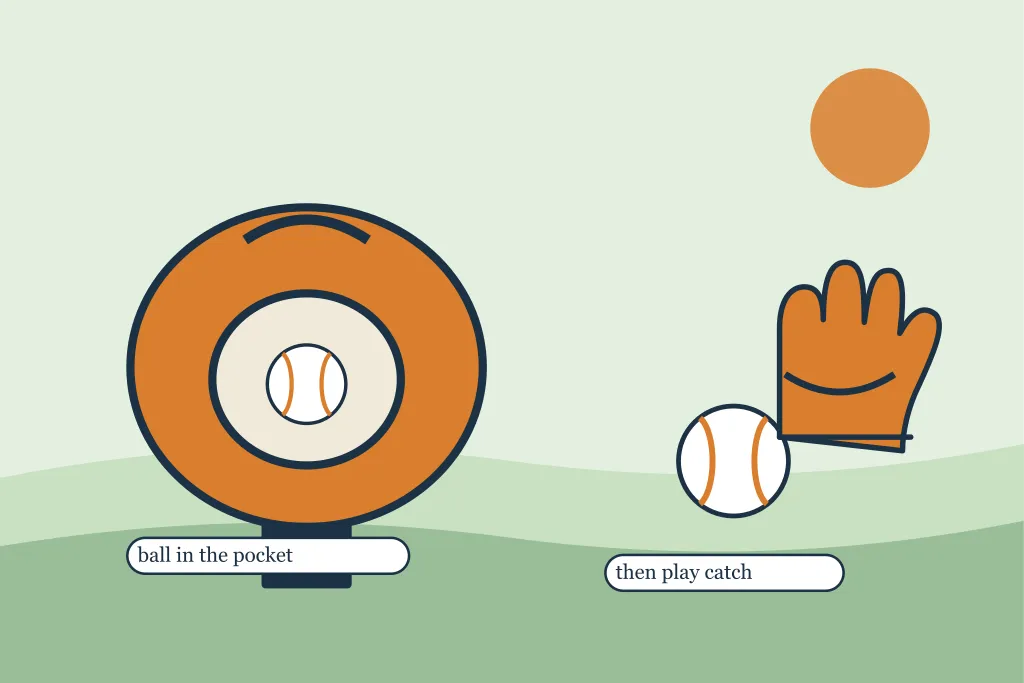
Place a baseball in the pocket, fold the glove closed and wrap it with rubber bands. Leave it in a cool, dry place for about a day (Rawlings).
4
Play catch
Use the glove regularly: Rawlings says hand oils, ball impact and opening and closing the glove continue the break-in.
5
Repeat where it still feels stiff
Wilson says to revisit any steps for parts that still feel overly stiff.
Keep early sessions short and soft. Easy tosses from a few feet away shape the pocket without stinging a small hand. Move back as the glove opens and closes more easily.
Methods compared
Break-in methods, what the makers say and our view
Method
What the maker says
Our view for kids
Play catch
Both finish with it
Always the final step
Ball and rubber bands overnight
Rawlings: about a day in a cool, dry place
Safe and easy
Light coat of conditioner
Rawlings: light coat, do not saturate
Fine if you use the maker's product, lightly
Mallet pounding
Wilson: form the pocket and pound the outside
Use gently on a child's first glove
Warm water in the palm
Wilson: warm, not boiling
Optional; skip it if you are unsure
Steaming, boiling, baking, heating
Rawlings: not recommended
Avoid
We include Wilson's warm-water step because it is the maker's own, but we do not recommend soaking a glove, and nothing in either guide calls for it. If you use water, follow Wilson's instructions exactly, keep the fingers up so it does not pool in the finger stalls, and let the glove dry before you use it.
Rawlings does not recommend steaming, boiling, baking or otherwise heating a glove. Read plainly, that rules out an oven, a microwave and a hot car trunk.
Two more warnings from Rawlings: do not use oily products such as petroleum jelly to soften leather, and do not run over the glove with a car. The point is the same in each case: heavy-handed shortcuts can damage the glove faster than they help break it in.
What to avoid and why
Avoid
Why
Oven, microwave, steam, boiling water
Rawlings does not recommend heating a glove
Hot car trunk or radiator
Same reason: heat
Petroleum jelly and oily products
Rawlings advises against them for softening leather
Saturating with oil
Rawlings: do not saturate; use a light coat
Soaking in water
Not part of either guide; Wilson uses warm water in the palm only
Rawlings says to inspect the laces every six months, store the glove in a cool, dry place with a ball in the pocket, and apply conditioner about once per season. That is a simple routine for a young player: a ball in the pocket at the end of each day, and a quick check of the laces at the start of each season.
Keep the glove out of the bottom of a wet bag. After practice, take it out so it can dry. A vented equipment bag helps; see our guide to building a multi-sport equipment bag and our storage ideas.
Tips for young players
Choosing the right size makes break-in easier: a glove that is too big for a small hand is hard to close, however well it is broken in. Use our glove size chart to check the size by age and position before you start. When your child is first learning, short play-catch sessions on a few days work better than one long one.
Parents often ask how long this takes. Neither maker gives a time. It depends on the glove and how often it is used, so judge by how it opens and closes, and the pocket's shape, rather than a number of days. If you want it done faster, shaping the pocket and playing catch together is the maker-approved route; heat is not.
Sizes and ranges here are makers' and leagues' published guidance, not a measurement of your child. Kids grow at different rates: check fit in person and follow your league's equipment rules.
There is no safe shortcut. Work the stiff spots by hand, shape the pocket around a ball with rubber bands, and play catch. Rawlings does not recommend steaming, boiling, baking or otherwise heating a glove, so skip ovens and microwaves.
How can I break in my baseball glove at home?
Twist the thumb and pinky to loosen the heel, apply a light coat of conditioner if you use one, put a ball in the pocket and wrap the glove for about a day, then play catch. That is Rawlings' method; no special tools are needed.
How long do baseball gloves take to break in?
Neither Rawlings nor Wilson gives a time. It depends on the glove and how often it is used. Judge by how easily it opens and closes and whether the pocket holds its shape.
Can you put a baseball glove in the oven or microwave to break it in?
No. Rawlings does not recommend steaming, boiling, baking or otherwise heating up a glove.
Should I use oil or conditioner on a new glove?
A light coat of the maker's conditioner is what Rawlings recommends; do not saturate the glove. Avoid oily products such as petroleum jelly. Check your glove's care tag.
What is the best way to shape a glove pocket?
Place a baseball in the pocket, fold the glove closed and secure it with rubber bands for about a day in a cool, dry place (Rawlings), then play catch. Wilson forms the pocket with a mallet.
This article reflects independent editorial research and disclosed buying criteria. This is not medical, coaching, or professional safety advice.
Some links on this page are Amazon Associates affiliate links; see our
affiliate disclosure for details.